Japanese Particles Explained: は vs が, を, に, で and the Full List
You can know every word in a Japanese sentence and still not know who did what to whom. The words don't tell you. The particles do — the little hiragana stuck to the end of each word: は, が, を, に, で.
They are the first real wall in Japanese, and the one most learners hit twice: once on day one, and again a year later when は and が still feel like a coin toss. This is the whole system — what each particle does, the list you actually need, and a way to decide between は and が that isn't a coin toss.
What are particles in Japanese, and why does word order barely matter?
English tells you who did what by order: the dog bit the man and the man bit the dog use the same words. Japanese barely uses order for that. It puts a label after each word instead, and the label carries the role:
私は駅で友達に本を渡した。 — Watashi wa eki de tomodachi ni hon o watashita. — "I handed the book to my friend at the station."
Four particles, four jobs. は marks what the sentence is about, で the place where the action happens, に the person receiving, を the thing handed over. Because the label travels with the word, you can shuffle the pieces — 私は本を駅で友達に渡した — and the meaning does not move. Only the verb is anchored, at the end.
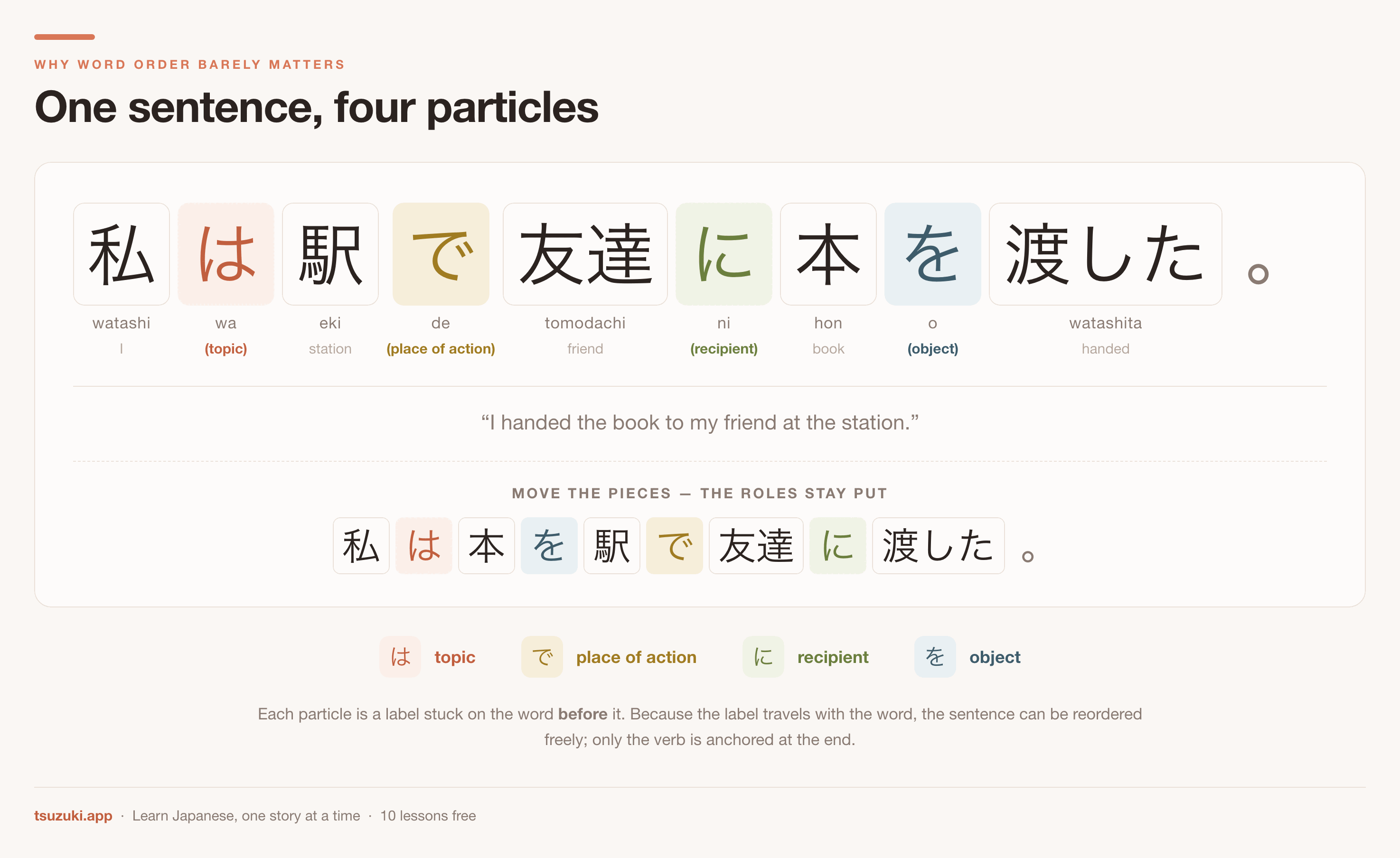
That is what a particle is: a postposition. English puts its little grammar words before the noun — at the station, to my friend. Japanese puts them after, and then gives them far more work than English prepositions ever do, including two jobs English has no word for at all: marking the subject, and marking the topic.
They are also everywhere. Hiragana make up about 37% of printed Japanese, and a large share of that is particles; in newspaper text, を is the single most frequent case particle, followed by に, が, で and と. If you learned the kana with the chart from our first article, you already met the one reading rule that matters here: は, へ and を are read wa, e and o when they work as particles. This is where that rule earns its keep.
The complete list of Japanese particles a beginner actually meets
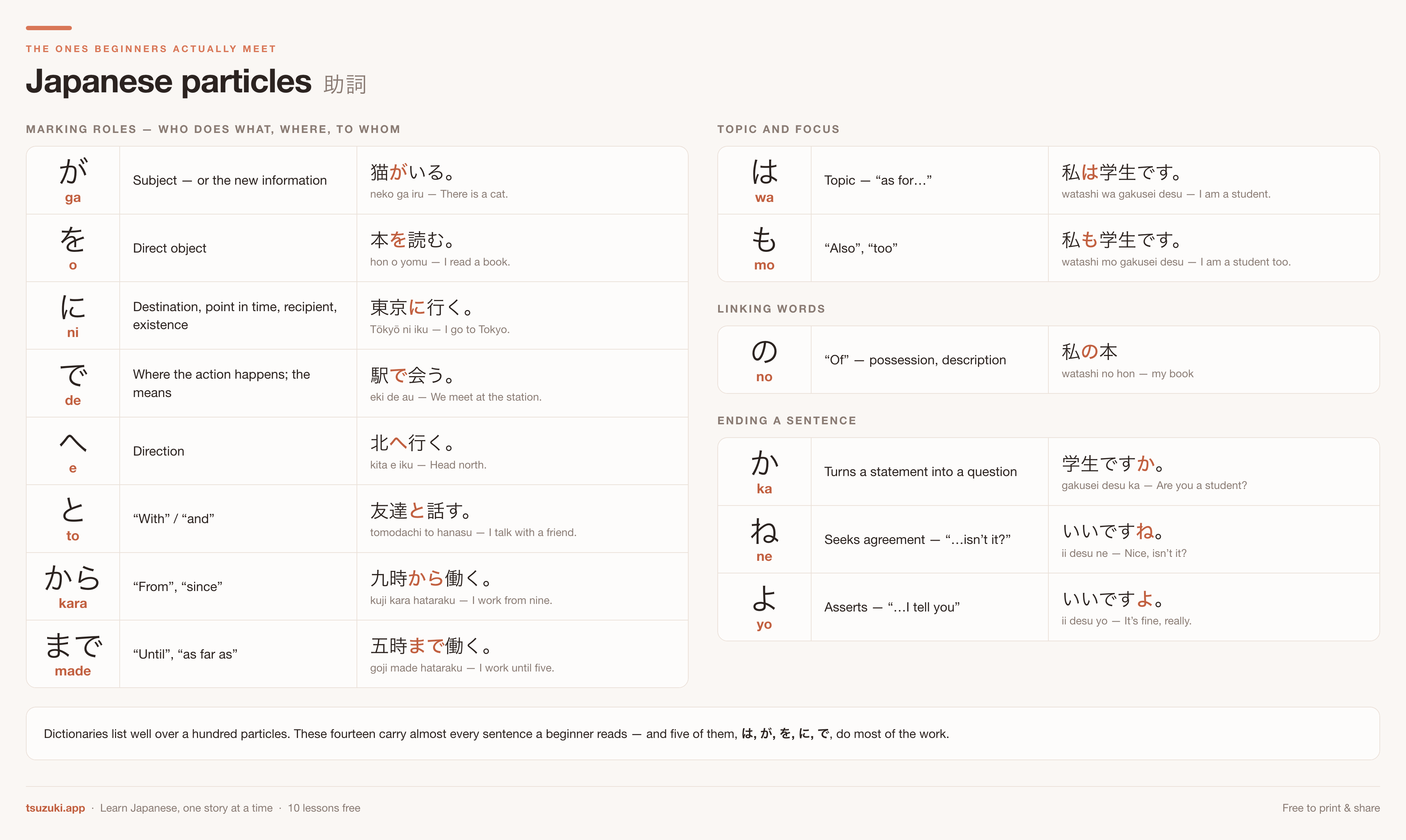
Dictionaries of particles run long. Kawashima's A Dictionary of Japanese Particles covers well over a hundred; a list of 188 circulates online. You need nothing like that number. Fourteen carry almost every sentence in a beginner textbook, and five of them do most of the work.
| Particle | Read | Job | Example |
|---|---|---|---|
| は | wa | Topic — "as for…" | 私は学生です。 Watashi wa gakusei desu. — I'm a student. |
| が | ga | Subject; new information | 猫がいる。 Neko ga iru. — There's a cat. |
| を | o | Direct object | 本を読む。 Hon o yomu. — I read a book. |
| に | ni | Destination, time, recipient, existence | 東京に行く。 Tōkyō ni iku. — I go to Tokyo. |
| で | de | Place of action; means | 駅で会う。 Eki de au. — We meet at the station. |
| の | no | "Of" — possession, description | 私の本 watashi no hon — my book |
| と | to | "With", "and" | 友達と話す。 Tomodachi to hanasu. — I talk with a friend. |
| も | mo | "Also", "too" | 私も学生です。 Watashi mo gakusei desu. — I'm a student too. |
| へ | e | Direction | 北へ行く。 Kita e iku. — Head north. |
| から | kara | "From", "since" | 九時から働く。 Kuji kara hataraku. — I work from nine. |
| まで | made | "Until", "as far as" | 五時まで働く。 Goji made hataraku. — I work until five. |
| か | ka | Question | 学生ですか。 Gakusei desu ka. — Are you a student? |
| ね | ne | Seeks agreement — "…isn't it?" | いいですね。 Ii desu ne. — Nice, isn't it? |
| よ | yo | Asserts — "…I tell you" | いいですよ。 Ii desu yo. — It's fine, really. |
The first five — は, が, を, に, で — decide whether a sentence is understood. The rest you will pick up from context within weeks. Each of the five gets its own section below, because each hides one trap that the one-line definition doesn't show.
The cheat sheet
The same fourteen, grouped by the job they do, as one printable image: Japanese particles cheat sheet (PNG). Free, no email required.
は (wa): the topic marker — not the subject marker
Most textbooks introduce は as "the subject marker" on page one, and every は/が problem you will ever have starts there. は does not mark the subject. It marks the topic: the thing the sentence is about, which you and the listener both already have in mind. The closest English is a spoken "as for…" — as for me, I'm a student.
The proof is that は happily marks things that are not subjects at all:
今日は暑いですね。 — Kyō wa atsui desu ne. — "(As for) today, it's hot, isn't it?"
象は鼻が長い。 — Zō wa hana ga nagai. — "(As for) elephants, the nose is long." — Elephants have long noses.
That second sentence is the title of Mikami Akira's 1960 book, and it is the whole argument in six characters: 象 is the topic, 鼻 is the grammatical subject, and Japanese marks them differently. Once you stop translating は as "subject", the sentence is transparent.
Two consequences follow. Two は in one breath is a contrast — 魚は食べます。肉は食べません。 Fish, I eat; meat, I don't — the は sets fish against meat. And は can never attach to a question word: 誰は, 何は, どこは do not exist, because a question word is by definition the thing you don't know yet, and は only marks what you already do.
Why は is pronounced wa
Because it's a fossil. Centuries ago the h-row kana shifted in pronunciation, and ha between vowels became wa. When Japan reformed its spelling in 1946 to match modern pronunciation, the three particles は, へ and を were deliberately exempted — too frequent and too recognisable to change. So kawa (river) went from かは to かわ, but the particle stayed は. Apart from the greetings こんにちは and こんばんは — the same particle, frozen — it is the only place you will read は as wa.
が (ga): the subject — and, more importantly, the new information
が marks the grammatical subject. But that description is useless for choosing between が and は, because the topic is usually also the subject. What が actually does is point at the information the listener doesn't have yet.
The clearest case is a question and its answer. The question word takes が, and so does the answer:
誰が来ましたか。 — Dare ga kimashita ka. — "Who came?"
田中さんが来ました。 — Tanaka-san ga kimashita. — "Tanaka came."
The second case is an announcement: something exists, something is happening, nothing is established yet. Susumu Kuno called this the が of neutral description:
雨が降っています。 — Ame ga futte imasu. — "It's raining."
猫がいます。 — Neko ga imasu. — "There's a cat."
Every Japanese folktale opens exactly this way — 昔々、おじいさんとおばあさんがいました。 Once upon a time, there was an old man and an old woman — and switches to は the moment they're introduced: おじいさんは山へ行きました。 The old man went to the mountain. が brings a character on stage; は keeps talking about them. If you learn one thing about は and が, learn that movement.
Three more places が is mandatory:
- Inside a subordinate clause. は almost never survives inside a clause that describes a noun or sets a time: 私が作ったケーキ the cake I made, 田中さんが来た時 when Tanaka came.
- With a handful of verbs and adjectives that take が where English expects an object: 寿司が好きです I like sushi, 日本語がわかります I understand Japanese, 時間があります I have time.
- When the subject is the whole answer — Kuno's exhaustive listing: 私が田中です。 I am Tanaka — as in, of the people here, the one you want is me.
は vs が: the decision, in four questions
Put the two together and you get a decision that most explanations turn into a page of exceptions. It isn't one. Ask four questions, in order, and stop at the first yes:
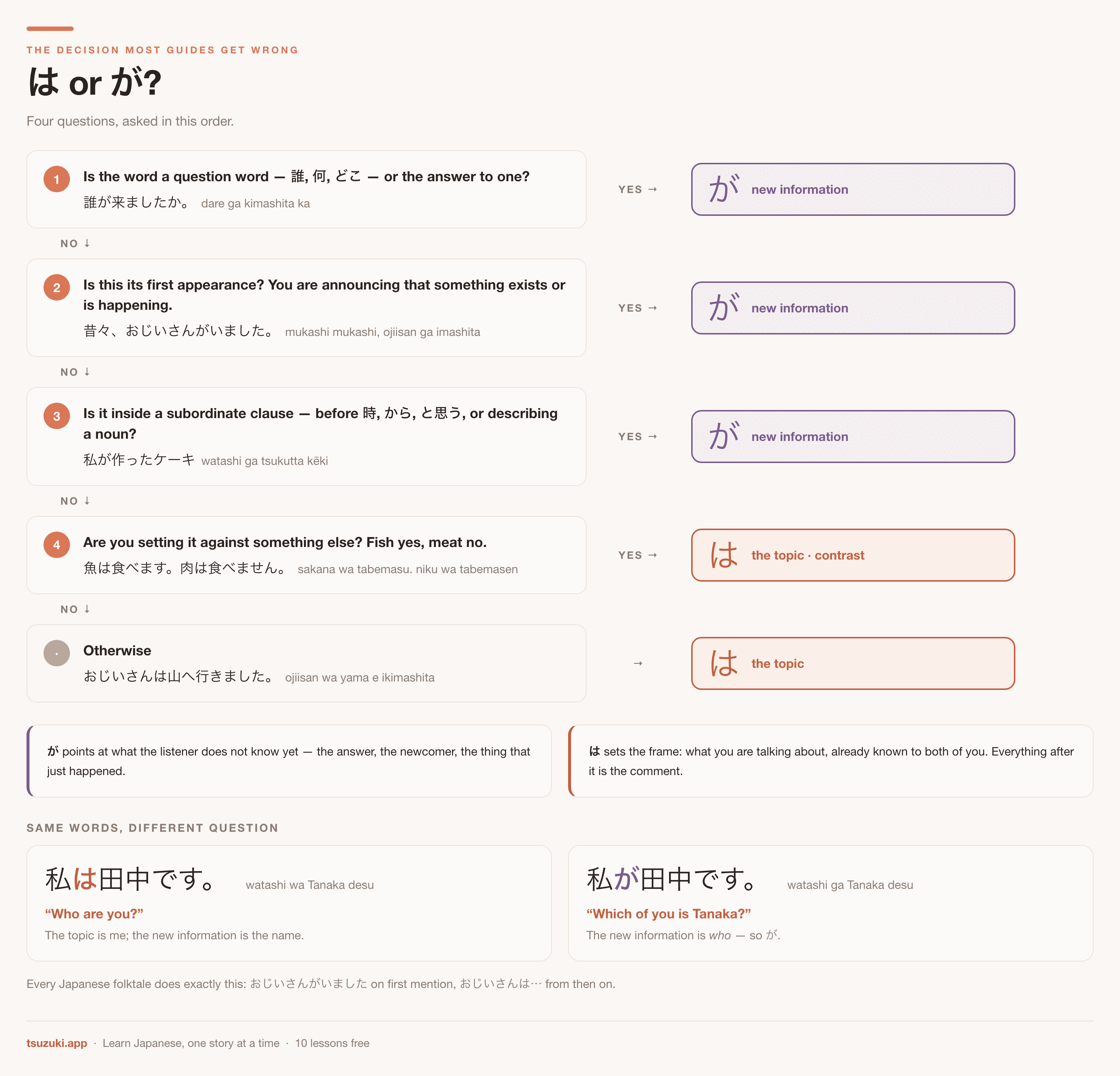
- Is the word a question word — or the answer to one? → が.
- Is this its first appearance — are you announcing that something exists or is happening? → が.
- Is it inside a subordinate clause? → が.
- Are you setting it against something else? → は, contrastive.
- Otherwise → は. It's the topic — the thing you're both already talking about.
The minimal pair to remember:
| Sentence | Reading | Answers the question… |
|---|---|---|
| 私は田中です。 | Watashi wa Tanaka desu. | "Who are you?" — the topic is me, the news is the name. |
| 私が田中です。 | Watashi ga Tanaka desu. | "Which of you is Tanaka?" — the news is who, so が. |
Same three words. The particle tells the listener which half of the sentence is the answer.
One honest caveat: you will still get this wrong for a while, and it matters less than you think. Particle mistakes make up a substantial share of all the grammatical errors learners produce (Oyama, 2010), and は/が is the pair that lasts longest — yet a native speaker will understand you either way. Get the folktale movement right — が to introduce, は to continue — and let the rest come from reading.
を (o): the direct object
を is the simplest of the five, and the one with the strangest spelling. It marks the direct object — the thing the verb acts on:
本を読みます。 — Hon o yomimasu. — I read a book.
ペンを二本ください。 — Pen o nihon kudasai. — Two pens, please.
That second line is from our article on numbers and counters: the pattern noun + を + number + counter + verb is how you ask for anything in a shop, and を is the hinge of it.
Two things to know. First, the spelling: を is written with a kana that was once read wo, and some rōmaji systems still write it that way, but it is pronounced o, identical to お. In modern Japanese this kana appears almost nowhere except as the particle — if you see を, it's the object marker. Second, を also marks movement through or out of a space, which trips people who learned it as "object" only: 公園を散歩します I walk through the park, 家を出ます I leave the house, 橋を渡る cross the bridge.
に (ni): destination, time, recipient — the particle of the point
に has more jobs than any other particle on the list, which is why it gets searched for as often as が. They are all the same job seen from different angles: に marks a point — a point you arrive at, a point in time, the person something arrives at, the place where something sits.
| Job | Example |
|---|---|
| Destination | 東京に行きます。 Tōkyō ni ikimasu. — I go to Tokyo. |
| Point in time | 七時に起きます。 Shichiji ni okimasu. — I get up at seven. |
| Recipient | 友達にメールを送ります。 Tomodachi ni mēru o okurimasu. — I send my friend an email. |
| Place where something exists | 机の上に本があります。 Tsukue no ue ni hon ga arimasu. — There's a book on the desk. |
| Result of a change | 先生になります。 Sensei ni narimasu. — I'll become a teacher. |
| Frequency | 週に三回 shū ni sankai — three times a week |
Note the time rule: に goes on specific points — 七時に, 月曜日に, 2026年に — and not on relative ones. 今日, 明日, 毎日, 来週 take no particle at all. (Seven o'clock is shichiji, not nanaji — one of the fixed readings we flagged in the numbers article.)
で (de): where the action happens, and by what means
If に is the point, で is the stage: the place where an action is performed, or the tool it's performed with.
図書館で勉強します。 — Toshokan de benkyō shimasu. — I study at the library.
電車で行きます。 — Densha de ikimasu. — I go by train.
日本語で話します。 — Nihongo de hanashimasu. — I speak in Japanese.
箸で食べます。 — Hashi de tabemasu. — I eat with chopsticks.
に vs で: the location trap
Both translate as "at" or "in", and this is the second most searched confusion after は/が. The distinction is clean once you look at the verb rather than the noun:
- に — where something is or ends up. Verbs of existence and arrival: いる, ある, 住む, 行く, 来る, 着く, 座る, 入る.
- で — where something is done. Every action verb: 食べる, 勉強する, 働く, 会う, 遊ぶ, 買う.
| に | で |
|---|---|
| 東京に住んでいます。 I live in Tokyo. (existence) | 東京で働いています。 I work in Tokyo. (action) |
| 駅にいます。 I'm at the station. | 駅で待ちます。 I'll wait at the station. |
| 椅子に座る。 Sit on the chair. (end up there) | 部屋で寝る。 Sleep in the room. (activity) |
The test: is the verb about being somewhere, or doing something there? Being → に. Doing → で.
The honest part: native speakers drop particles constantly
Listen to two friends talk and you will hear sentences with no particles at all: これ、食べる? This — eat? Spoken Japanese leaves out は, が and を all the time. In John Fry's analysis of the CallHome corpus — recorded phone calls between Japanese friends and family — roughly a third of subjects and half of objects carried no particle at all.
So why learn them? Three reasons. Written Japanese keeps them: books, subtitles, menus, any message with a hint of formality. Polite speech keeps most of them. And you can only drop a particle correctly if you know which one you're dropping — native speakers omit を when the context makes it obvious, not at random. Learn them fully, then earn the right to skip them.
The other honest point: a wrong particle rarely blocks understanding. A に where a で belonged gets a raised eyebrow, not a blank stare. That's an argument for using Japanese early and badly, not for a year of drills before your first sentence.
How to actually learn particles
Definitions are where particles go to die. Nobody learns に by memorising "destination, point in time, recipient, existence". Here is what works, in order:
- One anchor sentence per particle. Not a rule — a sentence you know cold. 私は学生です。猫がいる。本を読む。東京に行く。駅で会う。 When you meet a new use, you compare it to the anchor instead of consulting a list.
- Learn the folktale movement for は/が — が to introduce, は to continue — and ignore the other questions until it's automatic. It covers most real cases.
- Read with your finger on the particles. Before you read the particle after a noun, guess it. This is the retrieval practice that fixes kana in a week, applied to grammar: predict, check, move on.
- Fill-in-the-blank drills, particles only. Take sentences you understand, blank the particles, fill them back in. Twenty a day for a month does more than any explanation.
- Stop worrying about に vs で once you have the verb test. Being → に, doing → で. Every remaining case is a fixed expression you'll learn as vocabulary.
How this works in Tsuzuki
Tsuzuki's grammar cards are built on exactly this idea. Every pattern is a fixed frame — the particles and the copula — with coloured slots for the words that change: the very first pattern of lesson 1 is 〔name〕さんは〔identity〕です, and the particle is the part that never moves. The fill-in exercises check the frame rather than your vocabulary, and flag the particle you dropped. You learn particles by watching them hold a sentence together, again and again, inside a story.
Frequently asked questions
How many particles are there in Japanese? It depends how you count. Kawashima's dictionary covers over a hundred; a popular list reaches 188 by counting every variant and compound. A beginner meets about fourteen, and five — は, が, を, に, で — do most of the work.
Is は the subject marker? No. は marks the topic — what the sentence is about. It often coincides with the subject, which is why textbooks blur the two, but 今日は暑い (as for today, it's hot) and 象は鼻が長い (elephants, the nose is long) show it isn't. The subject marker is が.
Why is は pronounced wa? A historical sound change turned ha into wa between vowels, and the 1946 spelling reform kept the old spelling for the three particles は, へ and を. Everywhere else the kana is read ha.
What's the difference between に and で? に marks where something is or arrives — 東京に住む, 駅にいる. で marks where an action happens or the means used — 東京で働く, 電車で行く. Look at the verb: being → に, doing → で.
Can I drop particles like native speakers do? Eventually. In casual speech natives omit は, が and を constantly, but they know which one they're skipping. Learn them fully first; in writing and polite speech they stay.
Which particles should I learn first? は, を and the copula です carry a first lesson; add が, に and で in the first week; の, と, も and か within the month. The rest arrive on their own.
Start noticing, not memorising
Particles are the joints of a Japanese sentence. Everything else — vocabulary, kanji, verb forms — hangs off them, and once you read them automatically, a sentence stops being a string of words and becomes a structure you can see.
The way there is not a chart. It's a thousand sentences read with your attention on the little hiragana between the words, guessing each one before you read it. Anchor sentences first, the folktale movement for は/が, the verb test for に/で, and then volume.
Tsuzuki gives you that volume as a story: every line of dialogue, every grammar card and every fill-in exercise puts the particles in front of you as the fixed frame that holds the meaning — in kana, in kanji with furigana, or in raw kanji, never in rōmaji. The first 10 lessons are completely free — create an account at tsuzuki.app and start reading.
続けましょう! (Let's keep going.)
Sources: Kuno, Susumu (1973), "The Structure of the Japanese Language", MIT Press; Mikami, Akira (1960), 象は鼻が長い (Zō wa hana ga nagai), Kurosio; Kawashima, Sue A. (1999), "A Dictionary of Japanese Particles", Kodansha; Fry, John (2003), "Ellipsis and wa-marking in Japanese Conversation", Routledge, as summarised in Shimojo, M., "Properties of particle 'omission' revisited", Toronto Working Papers in Linguistics; Oyama (2010), "Automatic Error Detection Method for Japanese Particles", Polyglossia 18; Japanese Cabinet notification on modern kana usage (現代かなづかい), 1946.