Japanese Numbers: The Complete Chart, the Counters, and Why 1–10 Isn't Enough
You can learn to say ichi, ni, san in about four minutes. You will then walk into a shop, try to ask for two of something, and discover that you cannot.
That gap is the whole subject. Japanese numbers are not a vocabulary list — they are a small system with three moving parts, and the list only gives you one of them. This is all three.
Why counting in Japanese isn't just memorising 1 to 10
Three things stand between the list and an actual sentence.
There are two number systems, not one. Japanese kept its own native numbers and borrowed a set from Chinese. Both are in daily use. Ni and futatsu both mean two, and they are not interchangeable.
You cannot count anything without a counter. Japanese never says "two pens". It says "pens, two long-thin-things". The counter changes with the shape of what you're counting, and picking the wrong one is the single most audible beginner mistake.
The numbers change shape when they meet a counter. 一 is ichi, 本 is hon, and 一本 is ippon — not ichihon. The writing gives you no warning at all.
None of this is hard. It is just never on the chart, which is why so many learners memorise 1–10 and then stall for months.
First, the writing
Every reading below is given in rōmaji for convenience, but you'll meet these numbers written in kanji and kana on menus, price tags and train platforms. If the script is still a wall, start with hiragana and katakana — it's a week's work and it makes everything after it faster.
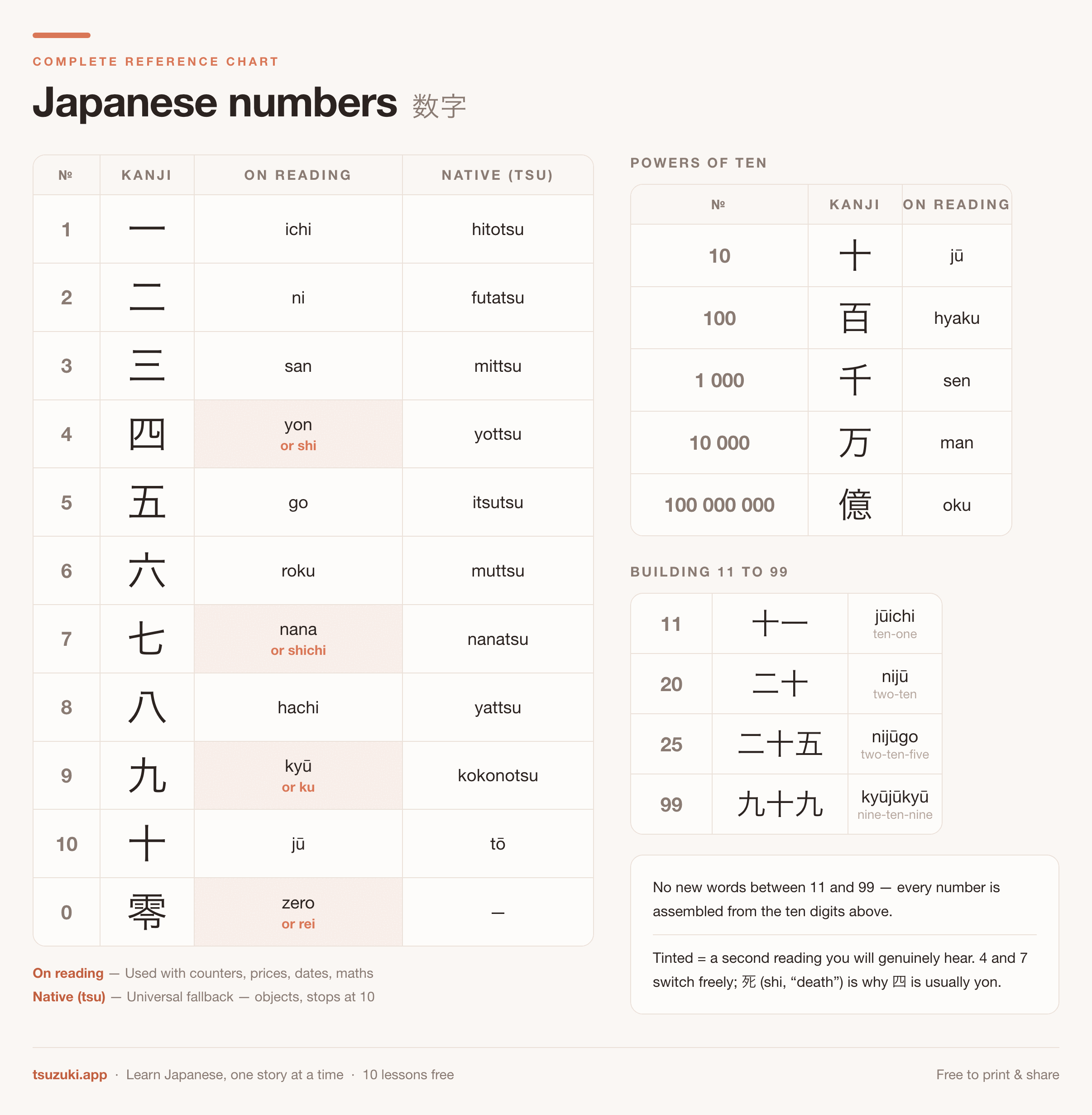
Japanese numbers 1 to 10 — both series
The left column is the on series (borrowed from Chinese). It is the one that scales: it works with counters, prices, dates, phone numbers and maths. The right column is the native series, which stops dead at ten.
| № | Kanji | On reading | Native (tsu) |
|---|---|---|---|
| 1 | 一 | ichi | hitotsu |
| 2 | 二 | ni | futatsu |
| 3 | 三 | san | mittsu |
| 4 | 四 | yon (or shi) | yottsu |
| 5 | 五 | go | itsutsu |
| 6 | 六 | roku | muttsu |
| 7 | 七 | nana (or shichi) | nanatsu |
| 8 | 八 | hachi | yattsu |
| 9 | 九 | kyū (or ku) | kokonotsu |
| 10 | 十 | jū | tō |
| 0 | 零 | zero (or rei) | — |
Learn the on series first. It's the one you'll use ninety percent of the time. The native series earns its place later, as an escape hatch — more on that below.
The four readings that trip everyone up
Four numbers have two competing readings, and you will hear both:
- 4 — yon or shi. Default to yon. Shi is also how you say 死, "death", so Japanese avoids it wherever it can. Hospitals skip floor four the way Western buildings skip thirteen.
- 7 — nana or shichi. Default to nana; shichi is easy to mishear as ichi.
- 9 — kyū or ku. Default to kyū. Ku also means 苦, "suffering".
- 0 — zero or rei. Zero in daily life; rei in formal and weather contexts.
The catch: telling the time reverses the defaults. 4 o'clock is yoji, 7 o'clock is shichiji, 9 o'clock is kuji. This is the clearest sign that these readings are not free choices — they're fixed per expression, and you learn them per expression.
Japanese numbers 11 to 100
Here Japanese is far kinder than English. There is no eleven, no twelve, no twenty. Everything from 11 to 99 is assembled from the ten digits you already have.
| Number | Japanese | Reading | Literally |
|---|---|---|---|
| 11 | 十一 | jūichi | ten-one |
| 12 | 十二 | jūni | ten-two |
| 20 | 二十 | nijū | two-ten |
| 25 | 二十五 | nijūgo | two-ten-five |
| 47 | 四十七 | yonjūnana | four-ten-seven |
| 99 | 九十九 | kyūjūkyū | nine-ten-nine |
The rule: multiplier before 十, remainder after. Twenty is "two tens". Twenty-five is "two tens five". That's the entire system up to 99, with zero new vocabulary.
Hundreds and thousands work identically with 百 (hyaku) and 千 (sen) — except for five forms that shift, for the same phonetic reasons as the counters below:
300 sanbyaku · 600 roppyaku · 800 happyaku · 3 000 sanzen · 8 000 hassen
The 万 wall: Japanese groups by four digits, not three
This is the part nobody warns you about, and it is the reason fluent-sounding learners still stumble over prices.
English chunks numbers in threes — thousand, million, billion. Japanese chunks them in fours — 万 (10 000), 億 (100 000 000). The comma in your head is in the wrong place, and every large number has to be silently regrouped before you can say it.
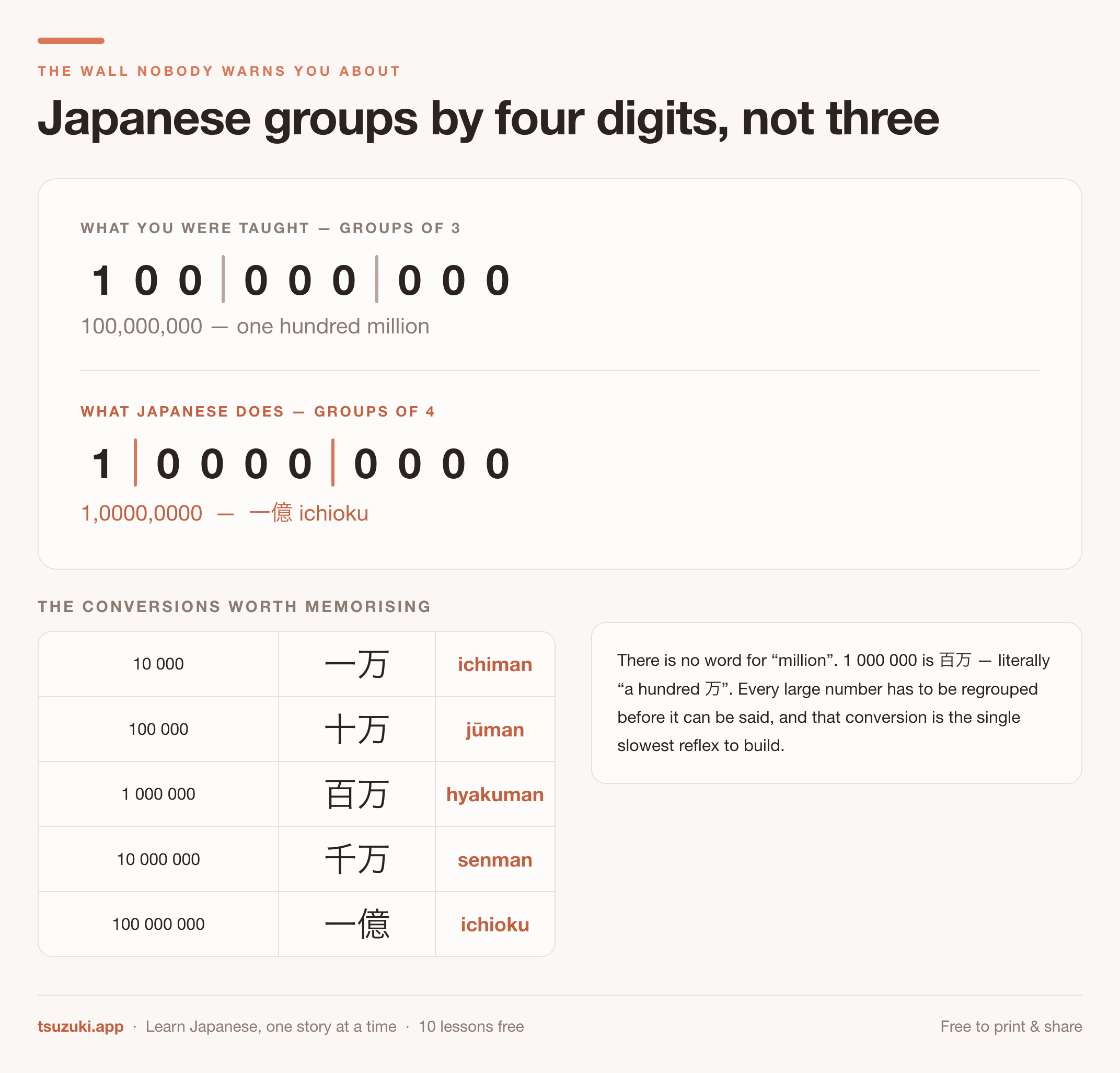
There is no word for "million". One million is 百万 — literally "a hundred 万". Ten thousand is not "ten thousand", it's 一万, one 万.
| Figure | Japanese | Reading |
|---|---|---|
| 10 000 | 一万 | ichiman |
| 100 000 | 十万 | jūman |
| 1 000 000 | 百万 | hyakuman |
| 10 000 000 | 千万 | senman |
| 100 000 000 | 一億 | ichioku |
A worked example, because this is a reflex and not a fact. A ¥35 000 coat:
split from the right in fours → 3|5000 → 三万五千円, sanman gosen en.
Not "thirty-five thousand". Three 万, five 千.
This conversion is genuinely slow to build. Give it deliberate practice with real prices and it becomes automatic in a few weeks; ignore it and it stays awkward for years.
Counters: the part the chart never mentions
In English you can say "three dogs" and "three books" with the same word. In Japanese you cannot. Every countable noun takes a counter — a suffix that classifies the thing by shape or category, closer to English "two sheets of paper" or "three head of cattle", except it's obligatory for everything.
The pattern is almost always:
noun + は/が/を … number + counter
ペンを二本ください。 — Pen o nihon kudasai. — "Two pens, please."
The particle carrying the noun — は, が or を — is a subject of its own; what concerns us here is the counter.
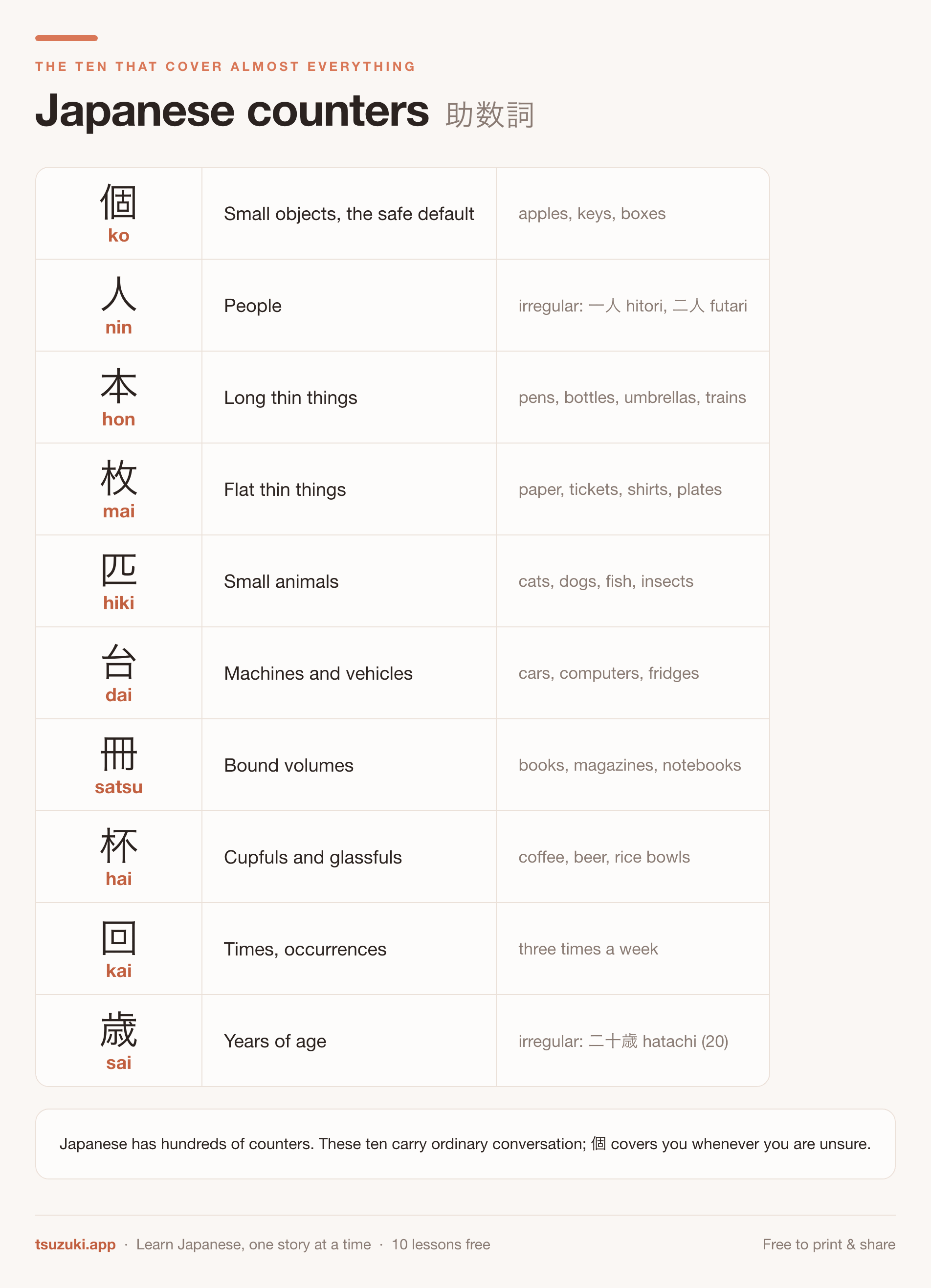
Japanese has hundreds of counters. You need about ten.
| Counter | Reading | What it counts | Examples |
|---|---|---|---|
| 個 | ko | Small objects — the safe default | apples, keys, boxes |
| 人 | nin | People | irregular: 一人 hitori, 二人 futari |
| 本 | hon | Long thin things | pens, bottles, umbrellas, trains |
| 枚 | mai | Flat thin things | paper, tickets, shirts, plates |
| 匹 | hiki | Small animals | cats, dogs, fish, insects |
| 台 | dai | Machines and vehicles | cars, computers, fridges |
| 冊 | satsu | Bound volumes | books, magazines, notebooks |
| 杯 | hai | Cupfuls and glassfuls | coffee, beer, rice bowls |
| 回 | kai | Times, occurrences | three times a week |
| 歳 | sai | Years of age | irregular: 二十歳 hatachi (20) |
When you don't know the counter, use 個
個 won't always be strictly correct, but it is always understood, and it is far better than freezing mid-sentence. Native speakers do this too when an object is ambiguous.
The sound changes, and why they're not optional
Here is the part that makes counters feel harder than they are. When a number meets a counter, the sound often changes — and the written form gives you no clue whatsoever.
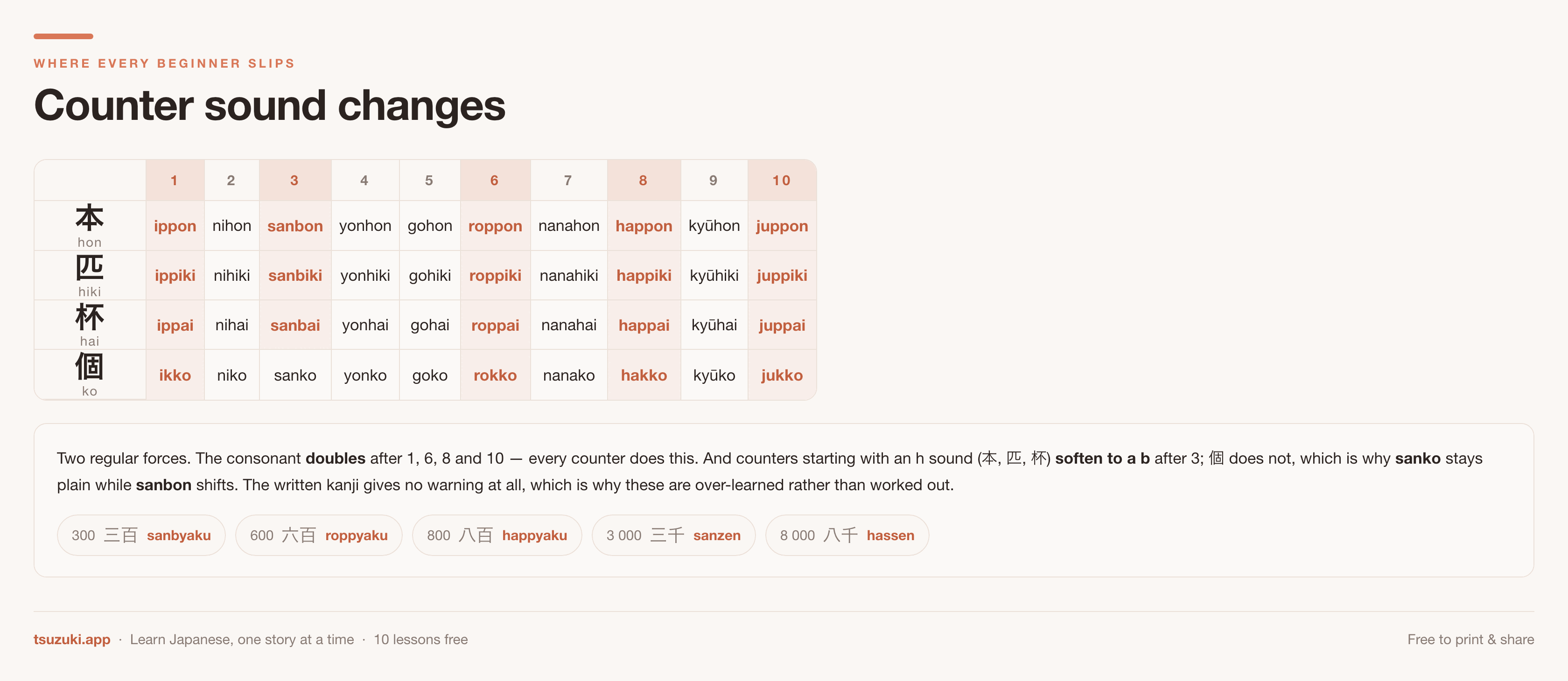
Two regular forces are at work:
Doubling after 1, 6, 8 and 10. Those numbers historically ended in a stop, so the boundary tightens into a small っ and the following consonant doubles. An h-sound hardens all the way to p: 一本 ippon, 六本 roppon, 八本 happon, 十本 juppon.
Softening after 3. Counters beginning with an h-sound voice to a b after the nasal in san: 三本 sanbon, 三匹 sanbiki, 三杯 sanbai.
The second rule only applies to h-counters. 個 begins with a k, so it stays plain — sanko, never sango. That distinction is exactly the kind of thing a chart glosses over and a learner then gets wrong for a year.
2, 4, 5, 7 and 9 never change. Which means the whole problem is five numbers, four counters, and about twenty forms worth over-learning.
The つ escape hatch
Remember the native series — hitotsu, futatsu, mittsu? Here's what it's for.
For objects, up to ten, the つ series works as a universal counter. You attach nothing:
りんごを三つください。 — Ringo o mittsu kudasai. — "Three apples, please."
No counter, no sound change, always correct for ordinary objects. It doesn't work for people, and it stops at ten — but between one and ten it is the most useful safety net a beginner has. Learn it early, precisely so that not knowing the right counter never stops a sentence.
Age, dates and money — the honest warning
Three everyday domains are irregular enough to deserve separate study rather than derivation:
Age uses 歳/才 (sai) and is mostly regular, with one famous exception: 20 years old is 二十歳 hatachi, not nijūsai.
Dates are the worst corner of the language for a beginner. Days 1 to 10 use the native series with irregular readings — 一日 tsuitachi (not ichinichi), 二日 futsuka, 三日 mikka, 十日 tōka — then mostly regularise, except 14th, 20th (hatsuka) and 24th. Don't derive them; learn them as vocabulary.
Money is refreshingly simple. 円 (en) is regular: 100円 hyaku-en, 1 000円 sen-en. The only real difficulty is the 万 regrouping above, which is why Japanese prices feel hard long after the numbers themselves are easy.
How to actually learn this
The order that works, and it isn't the order the charts imply:
- The on series 1–10. Twenty minutes. Everything else builds on it.
- The 11–99 assembly rule. Another twenty minutes, and you've got a hundred numbers.
- The つ series. Now you can count objects in a shop today, without any counter knowledge at all.
- Five counters — 個, 人, 本, 枚, 台. That's most daily situations.
- The sound changes for those five. Drill them as whole words — ippon, sanbon, roppon — never as number-plus-counter to be assembled.
- The 万 regrouping, with real prices, out loud. This one is a reflex and only repetition builds it.
- Dates and the remaining counters, as vocabulary, over the following months.
The single highest-leverage habit: read prices out loud. Japanese shopping sites, train fares, menus. It exercises the on series, the counters and the 万 conversion at once, on numbers that actually occur.
Take the charts with you
The full number chart, the ten counters and the sound-change matrix, ready to print or keep on your phone: numbers chart · counters · sound changes. Free, no email required.
Frequently asked questions
How many number systems does Japanese have? Two in everyday use: the on series borrowed from Chinese (ichi, ni, san), which scales indefinitely, and the native series (hitotsu, futatsu), which stops at ten and works as a universal counter for objects.
Do I really need counters? Yes, for natural speech. But the つ series covers objects from one to ten with no counter at all, and 個 covers most of the rest, so you can function long before you know twenty of them.
Why is 一本 pronounced ippon and not ichihon? Numbers ending in a historical stop — 1, 6, 8, 10 — double the following consonant, and an h-sound hardens to p. It is regular, but the kanji gives no hint, so these forms are memorised as whole words.
Should I say yon or shi for 4? Yon by default. Shi survives in fixed expressions and in counting drills. For 4 o'clock it's neither — it's yoji.
What's the hardest part of Japanese numbers? Not the digits. It's the 万 regrouping: Japanese chunks large numbers in fours where English chunks in threes, so every big figure needs converting before you can say it.
How long does it take to learn Japanese numbers? The digits and the 11–99 rule take an hour. Functional counting with a handful of counters takes a week or two. The 万 reflex on large prices takes a few weeks of deliberate practice.
Start counting things
Numbers are the fastest-paying vocabulary in Japanese: they show up in every shop, every timetable, every conversation about age, price or quantity. And unlike kanji, the system is small — two series, ten counters, five sound changes and one regrouping rule.
Learn the on series today, use つ tomorrow to buy something, and add counters as you meet them. That order gets you counting in real situations within a week, instead of memorising a chart you can't yet use.
Tsuzuki teaches numbers the way you meet them — inside a continuing story, with audio, and with a display toggle that lets you read every line as kana, as kanji with furigana, or as raw kanji. The first 10 lessons are completely free — create an account at tsuzuki.app.
またね! (See you soon.)