Hiragana and Katakana: The Complete Chart and the Fastest Way to Learn Them
Every Japanese learner hits the same wall on day one: the writing. Not kanji — that comes later. The kana. Hiragana and katakana are the two syllabaries that carry roughly 43% of every printed Japanese sentence, and until you can read them, everything else you study sits on top of a translation layer that will slow you down for years.
This is the chart, the difference between the two scripts, and the method that gets both into your head in about a week.
Why kana come first, before anything else
Japanese is written with three systems at once. A single ordinary sentence uses all three:
私はコーヒーが好きです。 — I like coffee.
- Kanji (私, 好) — meaning-carrying characters borrowed from Chinese.
- Hiragana (は, が, きです) — grammar: particles, verb and adjective endings.
- Katakana (コーヒー) — the loanword kōhī, "coffee".
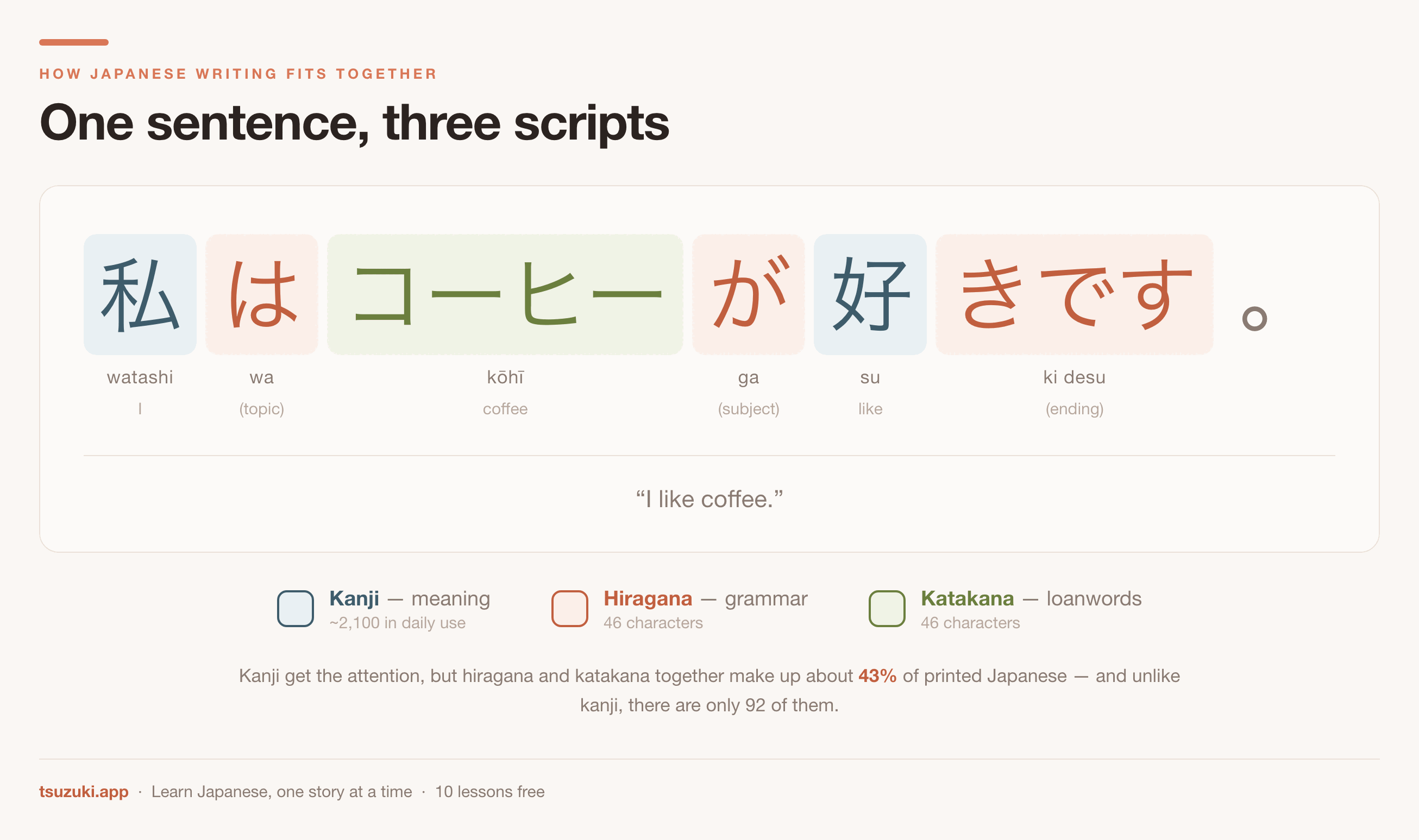
In a study of Asahi Shimbun text, kanji accounted for about 41% of printable characters, hiragana 37%, and katakana 6%. Kanji get all the attention, but the two kana scripts together are nearly as much of the page — and unlike the ~2,100 everyday kanji, there are only 46 basic characters per script. Finite, closed, learnable in days.
There is a harder reason too. Rōmaji is a dead end. Reading Japanese through
the Latin alphabet trains your mouth to produce English sounds and your eyes to
skip the actual writing. Every hour spent reading watashi wa instead of
わたしは is an hour of practice you will have to redo. Kana are not a hurdle
before the course — they are the first lesson.
How this works in Tsuzuki
Tsuzuki ships with no rōmaji mode at all. Every lesson can be displayed as 漢字 (kanji only), 漢字+ふりがな (kanji with reading hints above), or かな (kana only) — and furigana, the little reading hints, are themselves hiragana. Learning kana is what unlocks the door. It takes a few days, and it's the highest-leverage week of your entire study plan.
Hiragana vs katakana: what's the difference?
Both scripts encode exactly the same sounds. か and カ are both ka. They are two alphabets for one phonetic system — the difference is entirely about which words get written in which script.
| Hiragana ひらがな | Katakana カタカナ | |
|---|---|---|
| Shape | Round, cursive, flowing | Angular, sharp, blocky |
| Origin | Simplified cursive kanji | Fragments of kanji |
| Used for | Native Japanese words, grammar particles, verb/adjective endings, furigana | Loanwords, foreign names, onomatopoeia, plant & animal species, emphasis |
| Feels like | The default text | Italics + the foreign-word script |
| Example | たべる (taberu, to eat) | テレビ (terebi, TV) |
A useful shortcut: if it looks angular, it probably came from outside Japan. Katakana is where you'll find コンピューター (konpyūtā), アメリカ (Amerika), and your own name.
That said, katakana has a reputation for being the harder of the two, and it's deserved — for a reason that has nothing to do with the shapes. Roughly 80% of Japanese loanwords come from English, but they arrive reshaped by Japanese phonetics and often reshaped in meaning too. マンション (manshon) is an apartment, not a mansion. Recognising the characters is the easy half; recognising the word is the other half.
Which should you learn first?
Hiragana. It's the higher-frequency script, it carries the grammar, and every beginner textbook and every furigana reading hint is written in it. Learn hiragana to fluency, then start katakana while you're already reading real sentences — the second script goes much faster because you already know all 46 sounds. You're only relearning shapes.
The complete hiragana and katakana chart
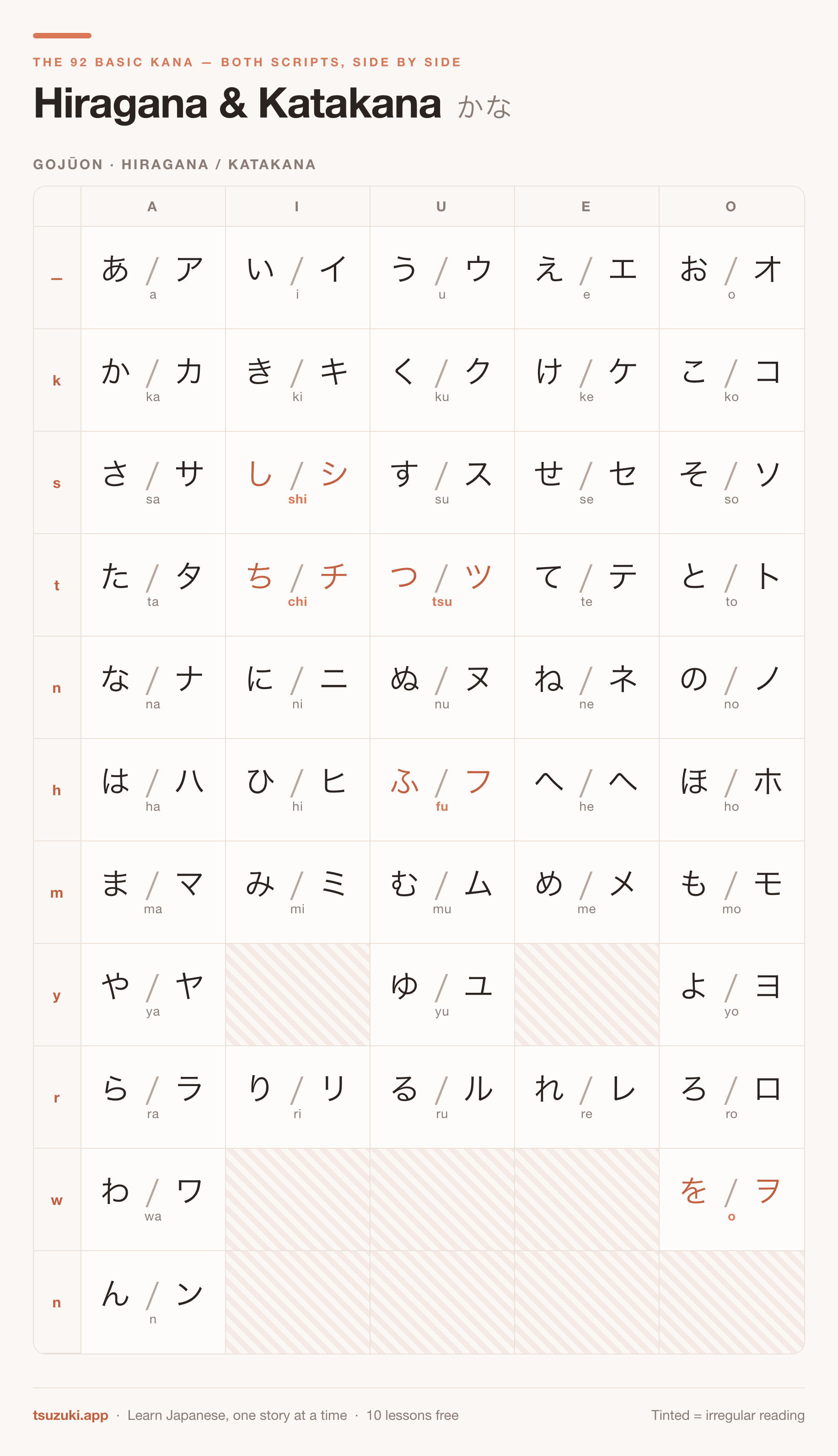
This is the gojūon (五十音, "fifty sounds") — the standard grid. Rows are consonants, columns are vowels. Each cell shows hiragana first, then katakana. In a hurry? Skip straight to the printable version.
| a | i | u | e | o | |
|---|---|---|---|---|---|
| – | あ ア a |
い イ i |
う ウ u |
え エ e |
お オ o |
| k | か カ ka |
き キ ki |
く ク ku |
け ケ ke |
こ コ ko |
| s | さ サ sa |
し シ shi |
す ス su |
せ セ se |
そ ソ so |
| t | た タ ta |
ち チ chi |
つ ツ tsu |
て テ te |
と ト to |
| n | な ナ na |
に ニ ni |
ぬ ヌ nu |
ね ネ ne |
の ノ no |
| h | は ハ ha |
ひ ヒ hi |
ふ フ fu |
へ ヘ he |
ほ ホ ho |
| m | ま マ ma |
み ミ mi |
む ム mu |
め メ me |
も モ mo |
| y | や ヤ ya |
— | ゆ ユ yu |
— | よ ヨ yo |
| r | ら ラ ra |
り リ ri |
る ル ru |
れ レ re |
ろ ロ ro |
| w | わ ワ wa |
— | — | — | を ヲ wo/o |
| n | ん ン n |
46 characters per script. Note the five irregulars — し shi, ち chi, つ tsu, ふ fu and を — they break the pattern and they're the ones beginners misread most.
Two characters that behave strangely
を is pronounced o, not wo, and in modern Japanese it appears almost exclusively as the object particle. ん is the only kana that isn't a full syllable — it's a standalone n sound, and it never starts a word.
Dakuten and handakuten: voicing marks
Add two small strokes (dakuten, ゛) or a small circle (handakuten, ゜) in the top-right corner and the consonant changes. No new shapes to learn — 25 extra sounds for free.
| a | i | u | e | o | |
|---|---|---|---|---|---|
| g | が ガ ga |
ぎ ギ gi |
ぐ グ gu |
げ ゲ ge |
ご ゴ go |
| z | ざ ザ za |
じ ジ ji |
ず ズ zu |
ぜ ゼ ze |
ぞ ゾ zo |
| d | だ ダ da |
ぢ ヂ ji |
づ ヅ zu |
で デ de |
ど ド do |
| b | ば バ ba |
び ビ bi |
ぶ ブ bu |
べ ベ be |
ぼ ボ bo |
| p | ぱ パ pa |
ぴ ピ pi |
ぷ プ pu |
ぺ ペ pe |
ぽ ポ po |
The logic is consistent: k→g, s→z, t→d, h→b, and h→p with the circle. ぢ and づ are pronounced identically to じ and ず and are rare — don't spend time on them.
Yōon: combination sounds
A full-size kana from the i-column plus a small や, ゆ or ょ produces a single blended syllable. 33 more sounds, still no new shapes.
| ya | yu | yo | |
|---|---|---|---|
| k | きゃ キャ kya |
きゅ キュ kyu |
きょ キョ kyo |
| s | しゃ シャ sha |
しゅ シュ shu |
しょ ショ sho |
| t | ちゃ チャ cha |
ちゅ チュ chu |
ちょ チョ cho |
| n | にゃ ニャ nya |
にゅ ニュ nyu |
にょ ニョ nyo |
| h | ひゃ ヒャ hya |
ひゅ ヒュ hyu |
ひょ ヒョ hyo |
| m | みゃ ミャ mya |
みゅ ミュ myu |
みょ ミョ myo |
| r | りゃ リャ rya |
りゅ リュ ryu |
りょ リョ ryo |
| g | ぎゃ ギャ gya |
ぎゅ ギュ gyu |
ぎょ ギョ gyo |
| j | じゃ ジャ ja |
じゅ ジュ ju |
じょ ジョ jo |
| b | びゃ ビャ bya |
びゅ ビュ byu |
びょ ビョ byo |
| p | ぴゃ ピャ pya |
ぴゅ ピュ pyu |
ぴょ ピョ pyo |
Total: 46 + 25 + 33 = 104 sounds per script. But only the first 46 are genuinely new shapes. That's the whole workload, and it's why kana are a weekend project rather than a semester.
So ignore the 104 for a moment. This is what you actually have to learn — 92 shapes, both scripts, on one screen:
Take the chart with you
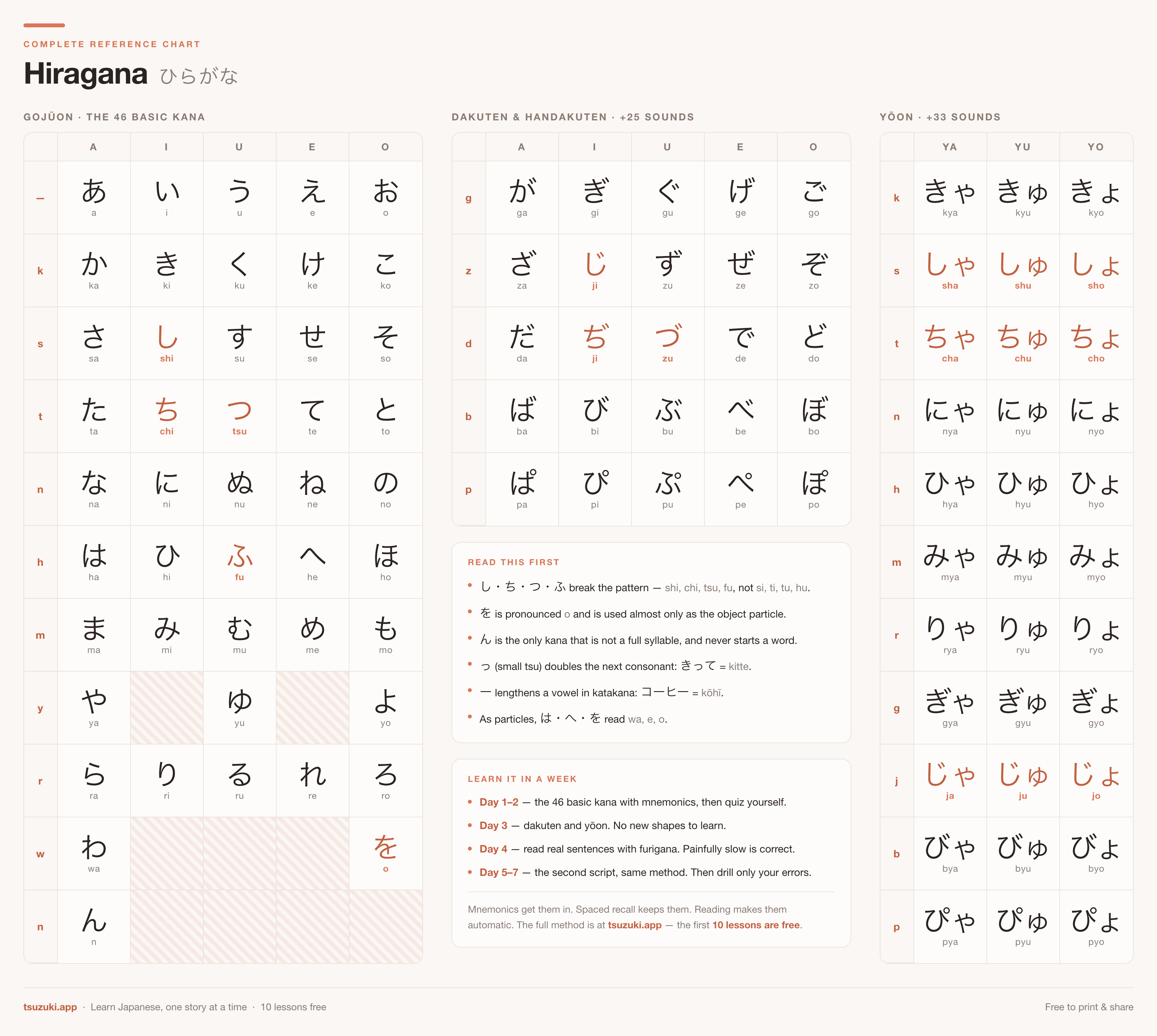
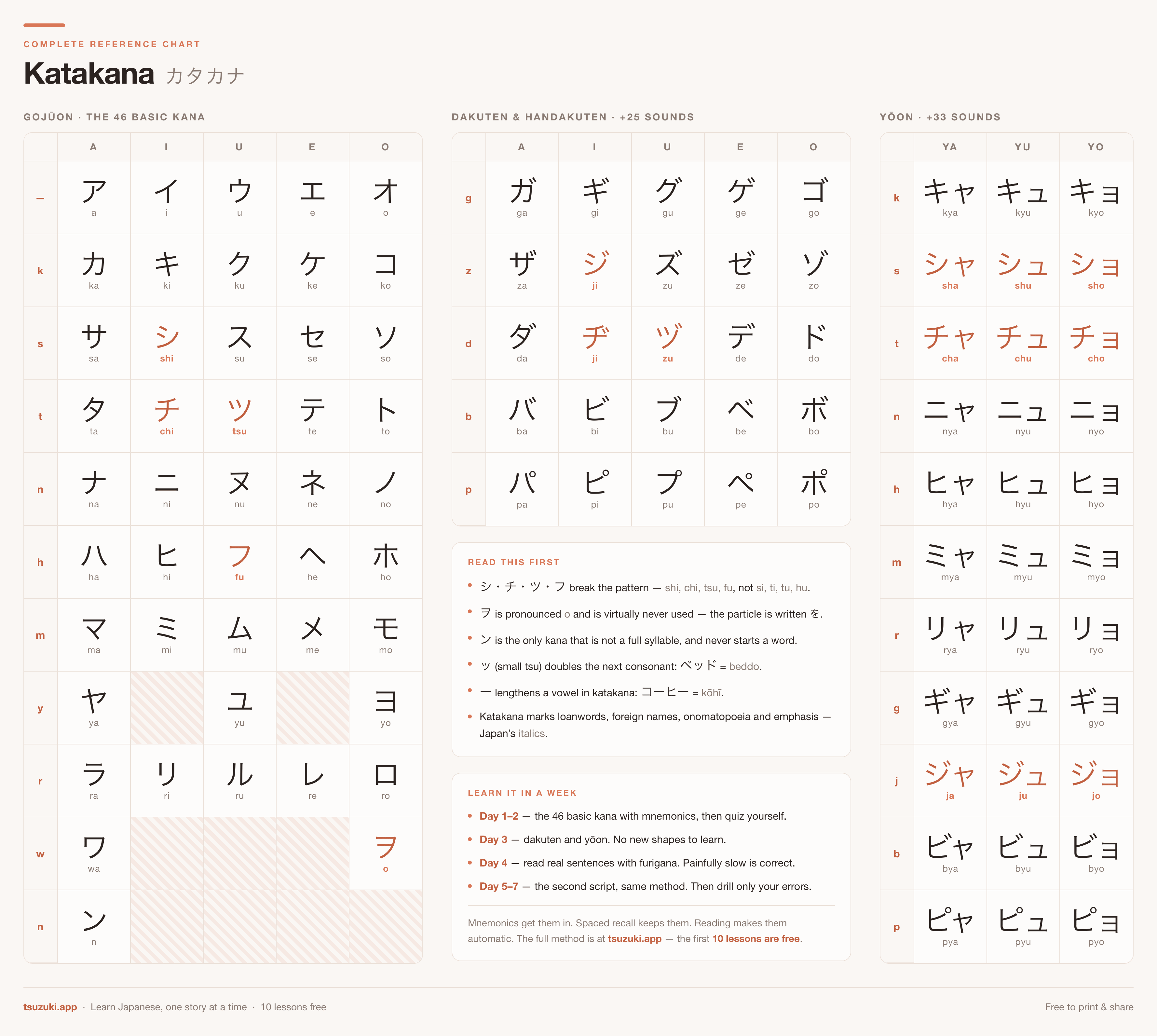
The complete version — both syllabaries with dakuten, combination sounds, the traps and a 7-day plan — as a print-ready A4 sheet: download the Tsuzuki kana chart (PDF). Free, no email required. Or save the images: hiragana · katakana.
Three marks that aren't characters
- っ / ッ (small tsu) — doubles the following consonant. きって = kitte (stamp), not kitsute.
- ー — the katakana long-vowel bar. コーヒー = kōhī. Hiragana lengthens vowels by adding a vowel kana instead (おかあさん, okāsan).
- は, へ, を as particles — は reads wa, へ reads e, を reads o. Only when they act as grammar particles. This is the single most common beginner misreading. What those particles actually do is a subject of its own.
How to learn kana: 6 methods, ranked
There is no shortage of methods. There is a very clear ranking between them, and it isn't a matter of taste — the memory research is unusually settled here.
1. Mnemonics — the best way to get characters in ⭐
Attach each character to a picture that encodes its sound. き looks like a key (ki). め is an eye — and me is literally the Japanese word for "eye". ね has a curling tail like a cat — neko.
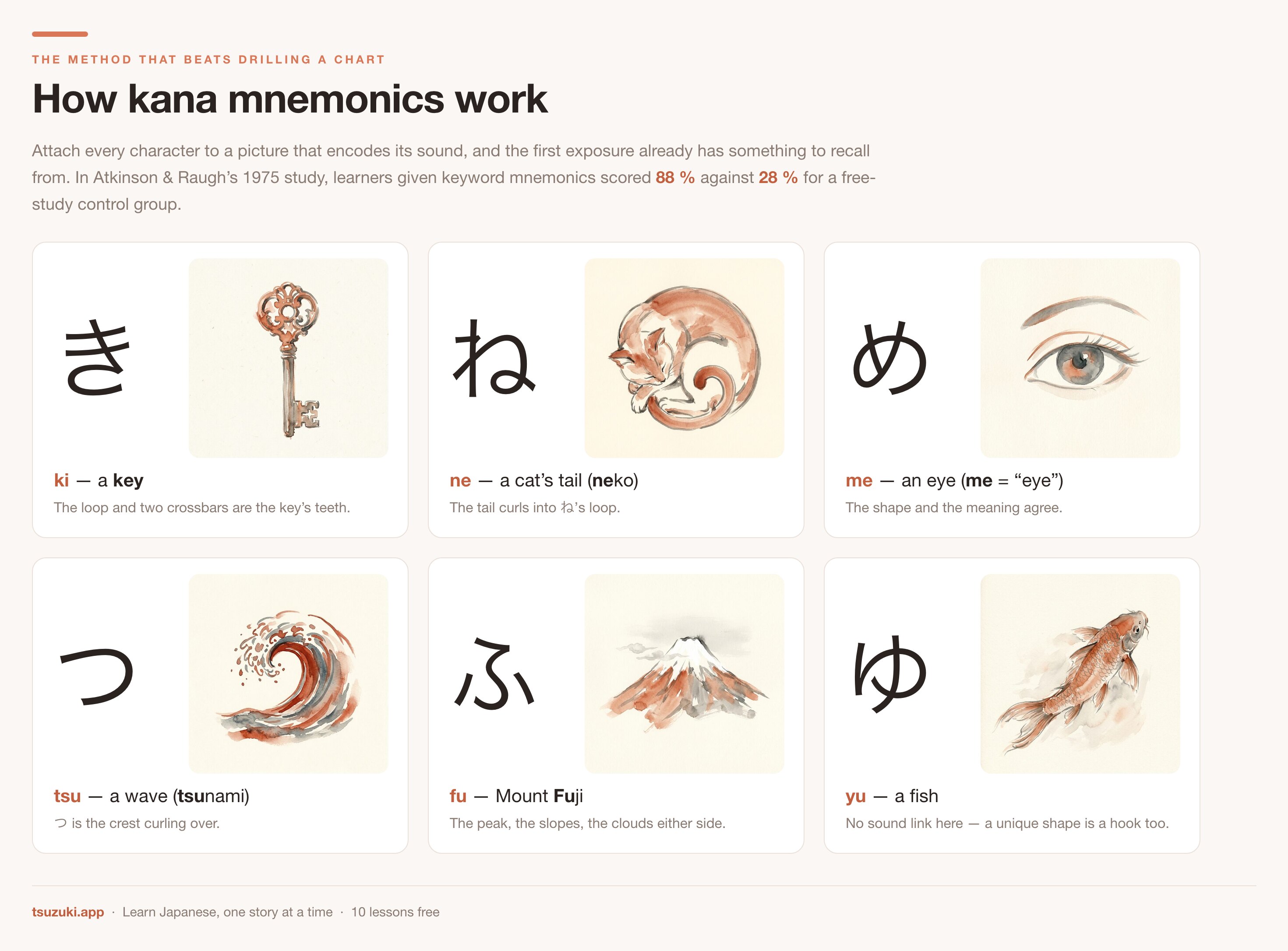
This is the keyword method, and it's one of the best-evidenced techniques in cognitive psychology. In Atkinson & Raugh's foundational 1975 study, learners given keyword mnemonics scored 88% on a final vocabulary test versus 28% for a free-study control group — and retained more six weeks later.
Cold-drilling a chart means brute-forcing recognition through raw repetition, with nothing to recall from. A mnemonic gives every character a hook on first exposure. Tofugu's free hiragana and katakana guides are the best-known implementation; Dr. Moku and the official Memory Hint apps do the same thing with animation.
Best for: the first pass. Weakness: mnemonics are scaffolding, not fluency — they must be discarded later, which is what step 2 does.
2. Spaced retrieval practice — the best way to keep them ⭐
Mnemonics get characters into memory; testing is what makes them stay. Roediger & Karpicke's work found that learners who practised active recall retained 61% of material after a week, versus 40% for those who simply reread it. Retrieval practice and spaced repetition are the only two techniques rated "high utility" in Dunlosky's landmark review of ten study strategies.
Practically: quiz yourself kana → sound, in random order, with increasing gaps. Anki, a kana quiz app, or a plain shuffled deck all work. What matters is that you recall rather than review. Rereading a chart feels productive and isn't — familiarity is not retrieval.
Best for: turning day-one recognition into permanent, instant reading.
3. Handwriting drills
Writing each character by hand engages motor memory and forces you to notice the differences your eyes gloss over — it is by far the most reliable cure for the シ/ツ and ソ/ン confusion below.
But it is slow. Tofugu's estimate is that learning to write doubles or triples the time to learn kana, and in 2026 most Japanese input is typed. Our take: read first, write second. Get reading fluency in a week, then add handwriting as a separate, unhurried habit — 10 minutes a day, not a prerequisite.
4. Rote chart repetition
Reciting あいうえお・かきくけこ down the gojūon grid is how kana are taught in Japanese schools. It builds real value: the row-and-column order is the Japanese alphabetical order, used by every dictionary, index and menu.
As a learning method on its own, though, it's the weakest option on this list — it's recognition without a hook and repetition without retrieval. Learn the grid order as reference; don't use it as your primary study loop.
5. Apps and games
Duolingo, Real Kana, Kana quiz apps: excellent at the thing beginners actually fail at, which is showing up daily. The gamified streak solves a motivation problem, not a memory problem. Most of them are quiz engines — which is method 2 in a nicer wrapper — so they work. Just check that yours drills kana → sound rather than multiple-choice recognition, which is far easier than real reading.
6. Reading real Japanese immediately
The finisher. As soon as you can decode ~80% of hiragana, stop drilling and start reading actual sentences with furigana. Slow, painful decoding of real text is what converts "I can recognise this character" into "I read this word". Nothing else does that job.
The verdict: what actually works
Mnemonics get them in. Spaced retrieval keeps them. Reading makes them automatic.
A concrete week that works for most learners:
| Day | What you do |
|---|---|
| 1 | All 46 hiragana with mnemonics — one pass, no pressure to retain |
| 2 | Quiz all 46, kana → sound, shuffled. Re-mnemonic whatever you miss |
| 3 | Dakuten, handakuten, yōon (no new shapes) + quiz |
| 4 | Read real hiragana sentences with furigana. Painfully slow is correct |
| 5–6 | All 46 katakana with mnemonics + quiz. Faster — same sounds |
| 7 | Mixed reading. Drill only your personal error list |
Then keep a 5-minute daily quiz running for two weeks while you read. That's it. Most learners reach comfortable reading in 3 to 7 days; some do it in a weekend. Anyone telling you kana take months is describing handwriting mastery, not reading.
The look-alikes that trip everyone up
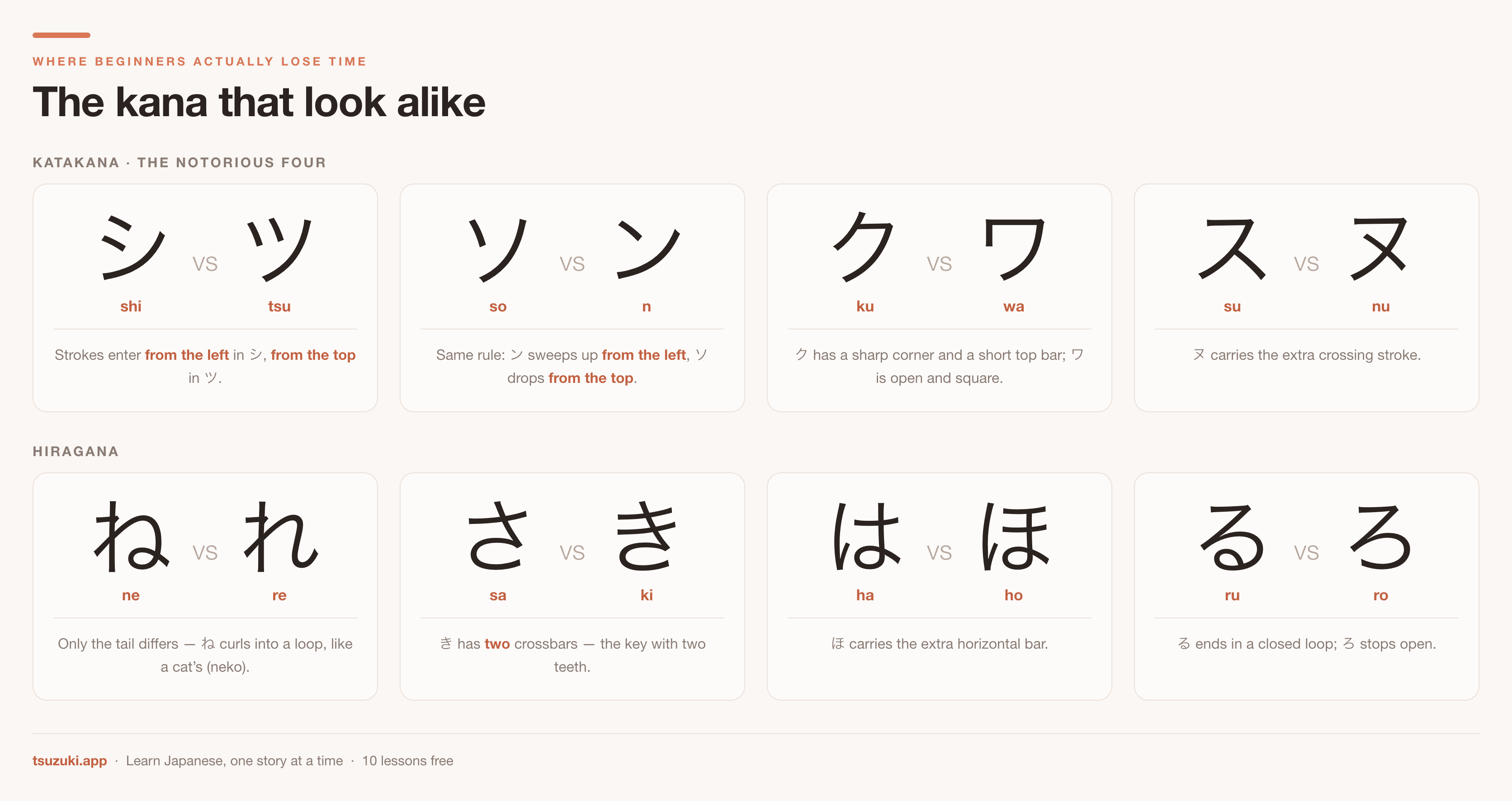
Budget your effort here. A handful of pairs cause the large majority of beginner errors:
Katakana — the notorious ones
| Pair | Trick |
|---|---|
| シ shi vs ツ tsu | シ's marks come in from the left (like the sweep of ン); ツ's drop from the top |
| ソ so vs ン n | Same rule: ン sweeps up from the left, ソ strokes down from the top |
| ク ku vs ワ wa vs ケ ke | ク has a sharp corner, ワ is open and square |
| ス su vs ヌ nu | ヌ has the extra crossing stroke |
| チ chi vs テ te | テ has two flat horizontals on top |
Hiragana
| Pair | Trick |
|---|---|
| ね ne / れ re / わ wa | Only the tail differs — ね curls into a loop (cat's tail), わ is open |
| さ sa vs き ki | き has two crossbars — it's the key with two teeth |
| は ha / ほ ho / ま ma | ほ has the extra horizontal bar |
| る ru vs ろ ro | る ends in a loop, ろ doesn't |
This is where handwriting practice pays for itself — writing シ and ツ ten times each teaches the stroke-direction difference in a way that looking at them never will.
Frequently asked questions
How long does it take to learn hiragana? Reading recognition: 2–4 days of focused study with mnemonics and quizzing. Add another 2–3 days for katakana. Handwriting fluency is a separate, longer project — plan weeks, and do it in parallel with real study.
Should I learn hiragana or katakana first? Hiragana. It's more frequent, it carries all the grammar, and furigana reading hints are written in it. Katakana comes second and goes faster.
Do I need kana before starting kanji? Yes. Kanji readings are written in kana, and every kanji study tool assumes you can read them. Kana first is not a preference; it's a dependency.
Is it OK to use rōmaji at the start? For your first few hours of pronunciation, fine. As a reading crutch, no — it builds a habit you'll spend months unlearning. Skip straight to kana.
How many kana are there in total? 46 basic characters per script (92 across both), expanding to 104 sounds each once you add dakuten, handakuten and combination characters. Only the 46 are new shapes.
What's the difference between hiragana, katakana and kanji? Hiragana and katakana are phonetic — each character is a sound, and there are 46 of each. Kanji are logographic — each carries meaning, and there are ~2,100 in everyday use. Kana are a week's work; kanji are a multi-year project.
Start reading, not drilling
Kana are the shortest, highest-return week in Japanese. A few days of mnemonics and self-testing and the writing system stops being a wall and becomes just… text.
The part most learners get wrong is what comes after: they finish the chart and go back to rōmaji study material, and the kana quietly fade. Don't. The moment you can decode most of hiragana, start reading real sentences — badly, slowly, with furigana. That's the step that makes it permanent.
Your kana chart, ready to print
Download the complete kana chart (PDF, A4) — hiragana and katakana, dakuten, combination sounds and the traps, on two printable pages. Free, no email required. Stick it above your desk.
Tsuzuki is built for exactly that transition: a Japanese course written as a continuing story, with a display toggle that lets you read every line as kana, as kanji with furigana, or as raw kanji — and never as rōmaji. The first 10 lessons are completely free — create an account at tsuzuki.app and start reading today.
がんばって! (Good luck.)
Sources: Atkinson & Raugh (1975), "A Mnemonic Method for Learning a Second-Language Vocabulary", Journal of Educational Psychology; Roediger & Karpicke (2006), "The Power of Testing Memory"; Dunlosky et al. (2013), "Improving Students' Learning With Effective Learning Techniques"; Tofugu's hiragana and katakana guides.