Japanese Kanji: How the System Actually Works (and Why 2,136 Isn't the Number That Matters)
Most people meet kanji as a threat: 2,136 characters, each with several readings, each apparently drawn from scratch. Framed that way it looks like years of flashcards before you can read a menu.
That framing is wrong, and it's why so many learners quit at this step. Kanji are not 2,136 unrelated drawings. They are a compositional system — a small set of parts, recombined — and roughly two thirds of them tell you how they're pronounced if you know where to look.
This is how the system works.
Why Japanese kept kanji at all
The reasonable first question is why a language that already has two phonetic alphabets bothers with thousands of characters. The answer is homophones.
Japanese has a small sound inventory, so identical-sounding words pile up. Spoken, context separates them. Written in kana alone, they'd be genuinely ambiguous.
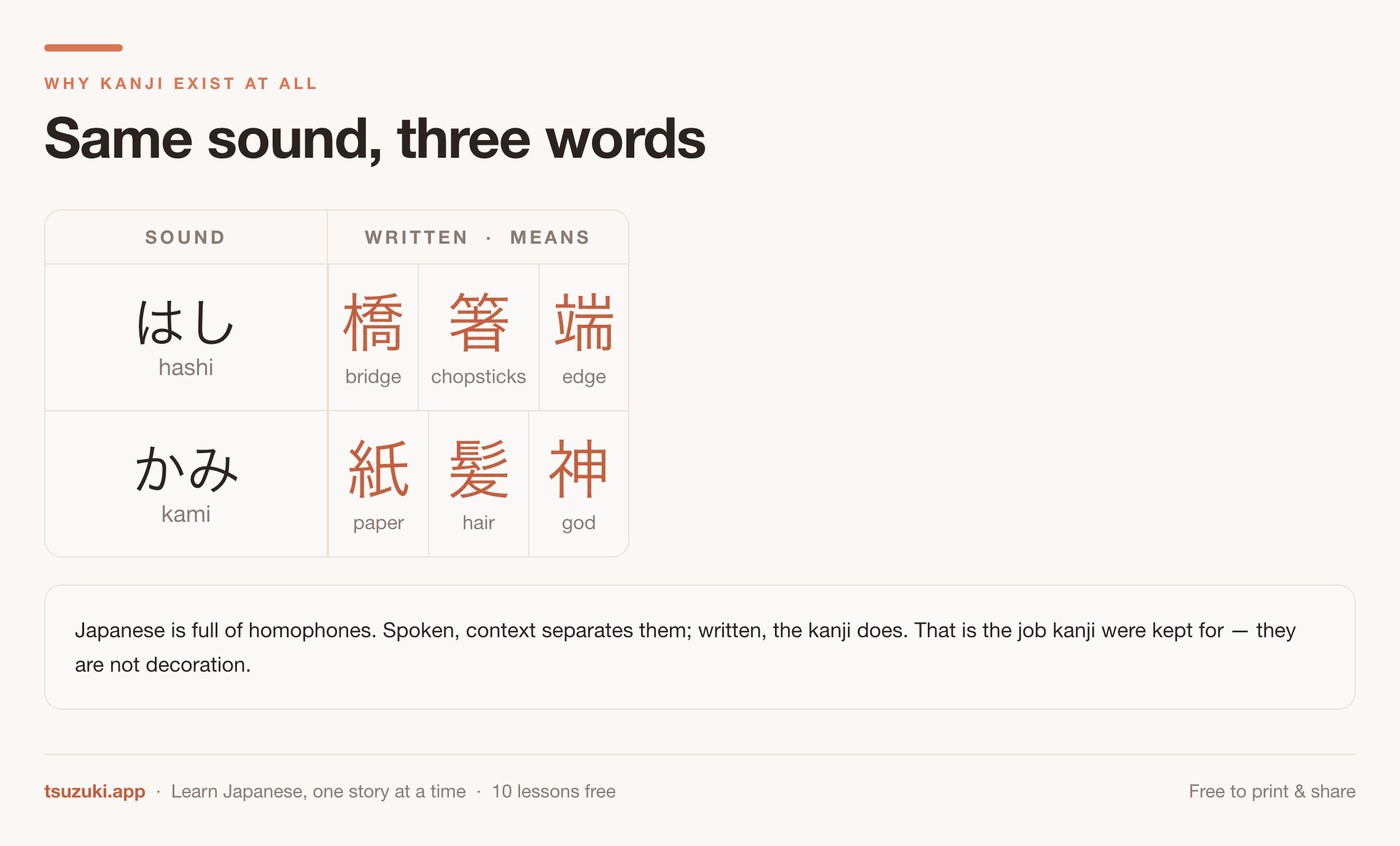
はし is hashi — 橋 (bridge), 箸 (chopsticks), or 端 (edge). かみ is kami — 紙 (paper), 髪 (hair), or 神 (god).
A sentence written only in kana forces you to disambiguate from context every few words. The kanji does it instantly. That's the job they were kept for, and it's why fluent readers find kanji text faster to read than kana text, not slower.
If the script itself is still new
This article assumes you can read kana. If you can't yet, start there — hiragana and katakana take about a week, and every kanji reading below is written in them.
How many kanji do you actually need?
The number everyone quotes is 2,136 — the jōyō set, the official list taught through Japanese school and used as the baseline for newspapers and official documents.
It's a real number, and it's the wrong one to plan around.
Coverage doesn't climb linearly. Character frequency in Japanese is steeply skewed: the most common 1,000 kanji account for roughly 95% of the characters in a newspaper. The remaining thousand-plus buy you the last few percent — the rare, the technical, the literary.
The practical consequence: you're reading real material long before you finish any list. A few hundred kanji and you can decode signage, menus and simple articles with a dictionary at hand. That's a matter of months, not years.
A kanji is assembled, not drawn
Here's the part most beginner resources skip, and it changes everything.
Very few kanji are invented as single units. The overwhelming majority are built from components — and in about two thirds of everyday kanji, those components split into two clear jobs.
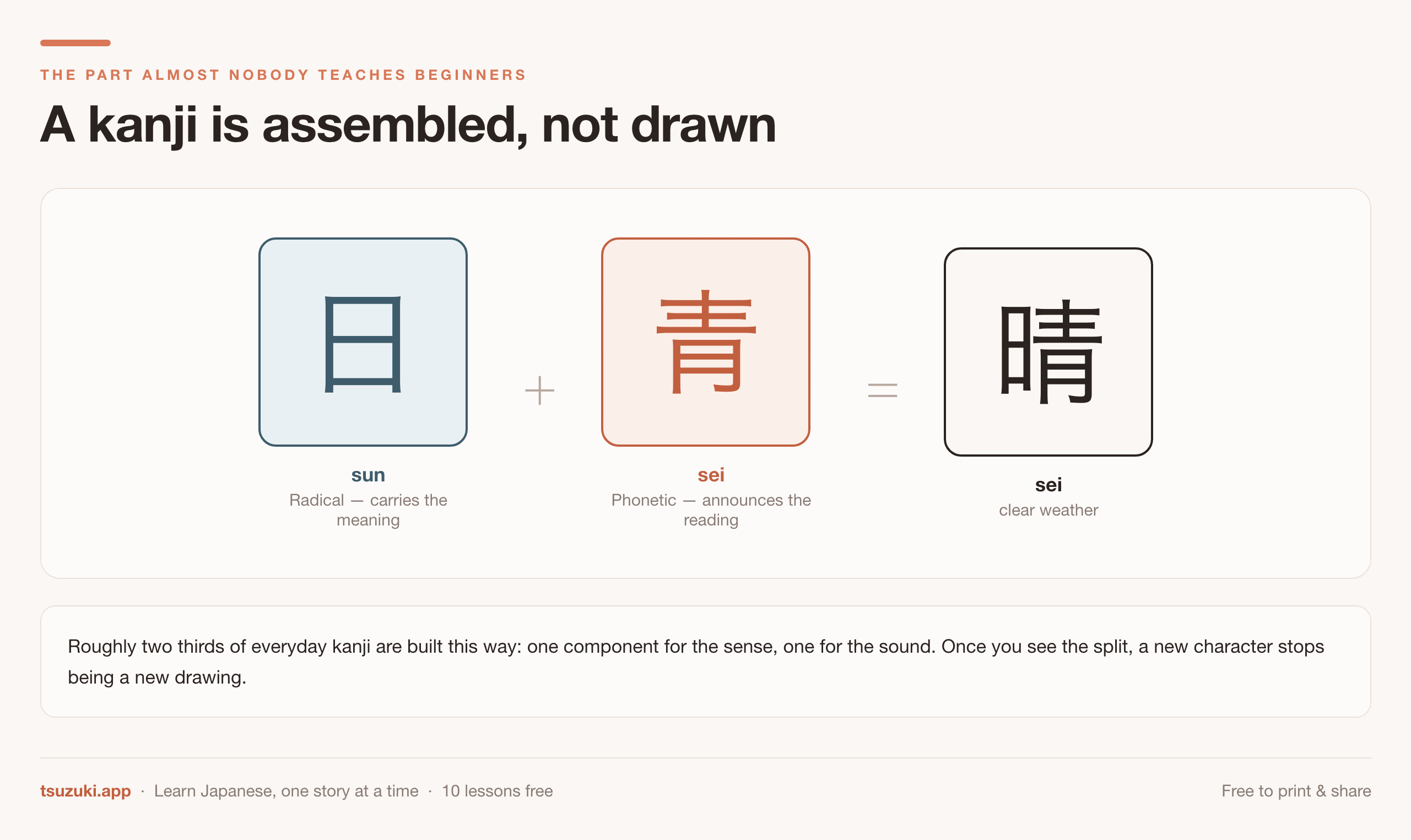
Take 晴 (sei, "clear weather"):
- 日 on the left is the radical — the sun. It tells you the character's domain of meaning. Weather, brightness, daytime.
- 青 on the right is the phonetic component. It carries no meaning here. It tells you the character is read sei.
These are called keisei-moji (形声文字), and they make up somewhere between 60% and 80% of the jōyō set depending on how you count. Once you can see the split, an unfamiliar kanji stops being a wall of strokes and becomes two recognisable parts.
The phonetic clue nobody teaches beginners
Now the payoff. If a component reliably signals a reading, then learning one component gives you the reading of every kanji built on it.
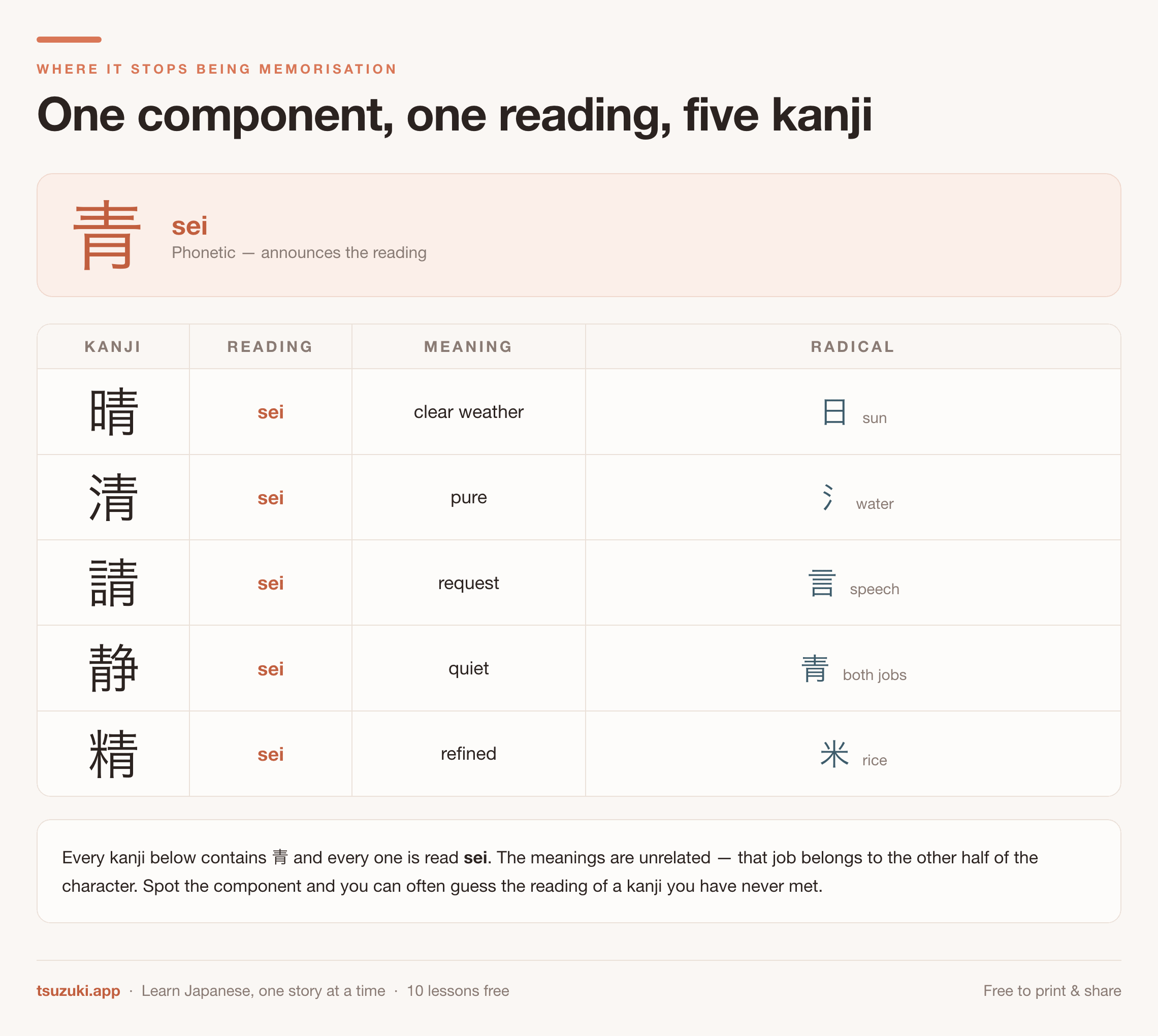
Every character above contains 青 and every one is read sei — but they mean clear weather, pure, request, quiet and refined. The meanings come from the other half; the sound comes from 青.
| Kanji | Reading | Meaning | Radical |
|---|---|---|---|
| 晴 | sei | clear weather | 日 sun |
| 清 | sei | pure | 氵 water |
| 請 | sei | request | 言 speech |
| 静 | sei | quiet | 青 (does both jobs) |
| 精 | sei | refined | 米 rice |
This is what separates learners who find kanji tractable from learners who find them endless. The second group is memorising 2,136 independent facts. The first group is learning a few hundred components and inferring.
Two honest caveats. The clue points at the on reading only, not the kun reading. And it isn't perfect — the pronunciations were borrowed from Chinese over many centuries, and some series have drifted. Treat it as a strong hint that's right far more often than chance, not a rule.
Why one character has several readings
The other thing that makes kanji feel arbitrary is that they have multiple readings. There's a clean historical reason.
When Japan imported the Chinese writing system, it already had spoken Japanese. So each character arrived with a Chinese pronunciation, and was also attached to the existing Japanese word for the same thing. Both survived.
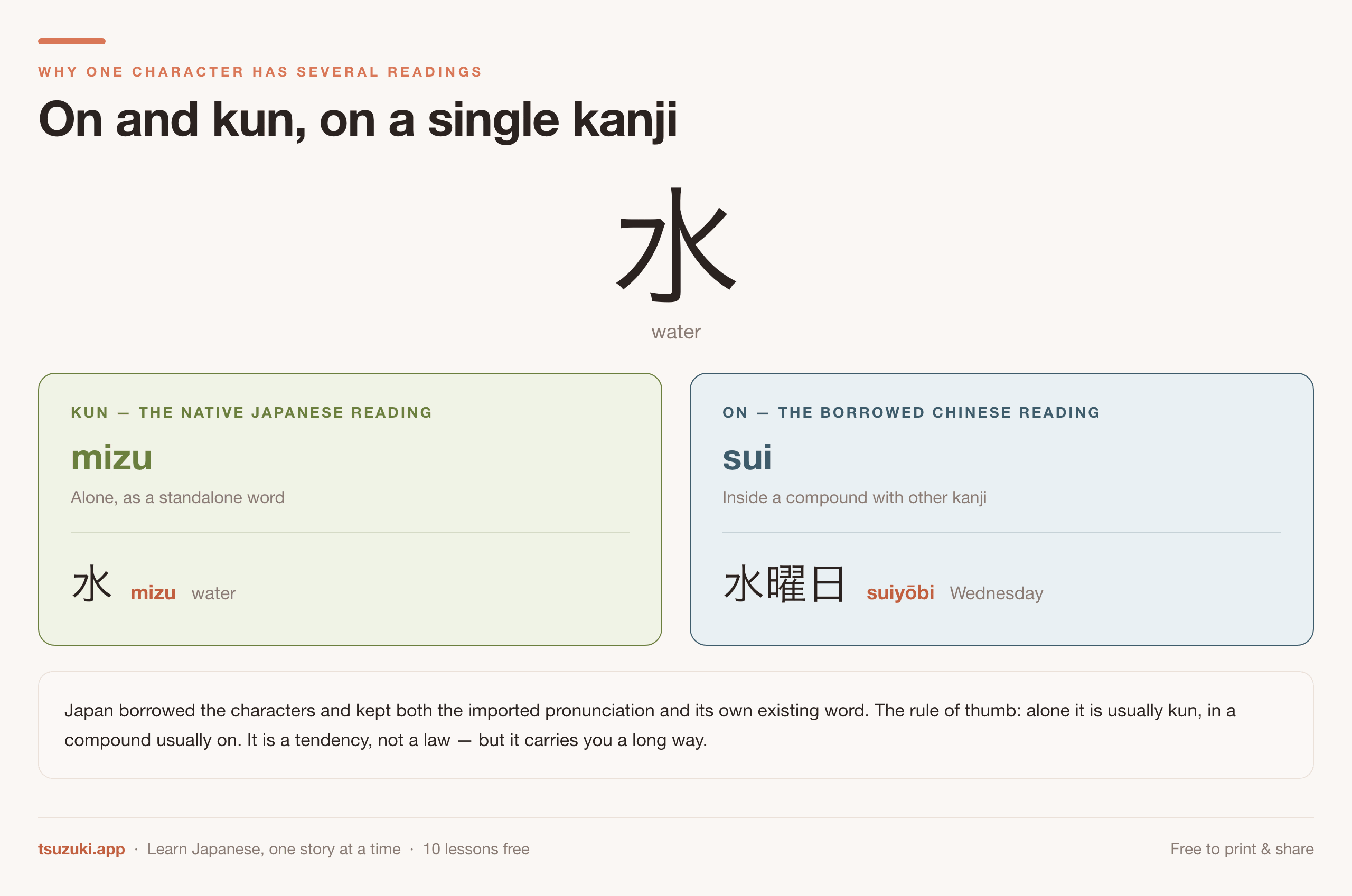
- kun'yomi (訓読み) — the native Japanese reading. 水 alone is mizu.
- on'yomi (音読み) — the borrowed Chinese reading. 水曜日 (Wednesday) is suiyōbi.
The rule of thumb: alone, usually kun; inside a compound with other kanji, usually on. It's a tendency rather than a law, and there are well-known exceptions, but it carries a beginner a surprisingly long way.
This is also why furigana exist — the small kana printed above a kanji to specify which reading applies. They aren't training wheels; adult Japanese text uses them whenever a reading is genuinely unpredictable, which happens most often with names.
Radicals: the parts worth learning first
If kanji are assembled, the components are the real vocabulary. There are about 214 traditional radicals, but that number is as misleading as 2,136 — perhaps a hundred do most of the work, and a few dozen appear constantly.
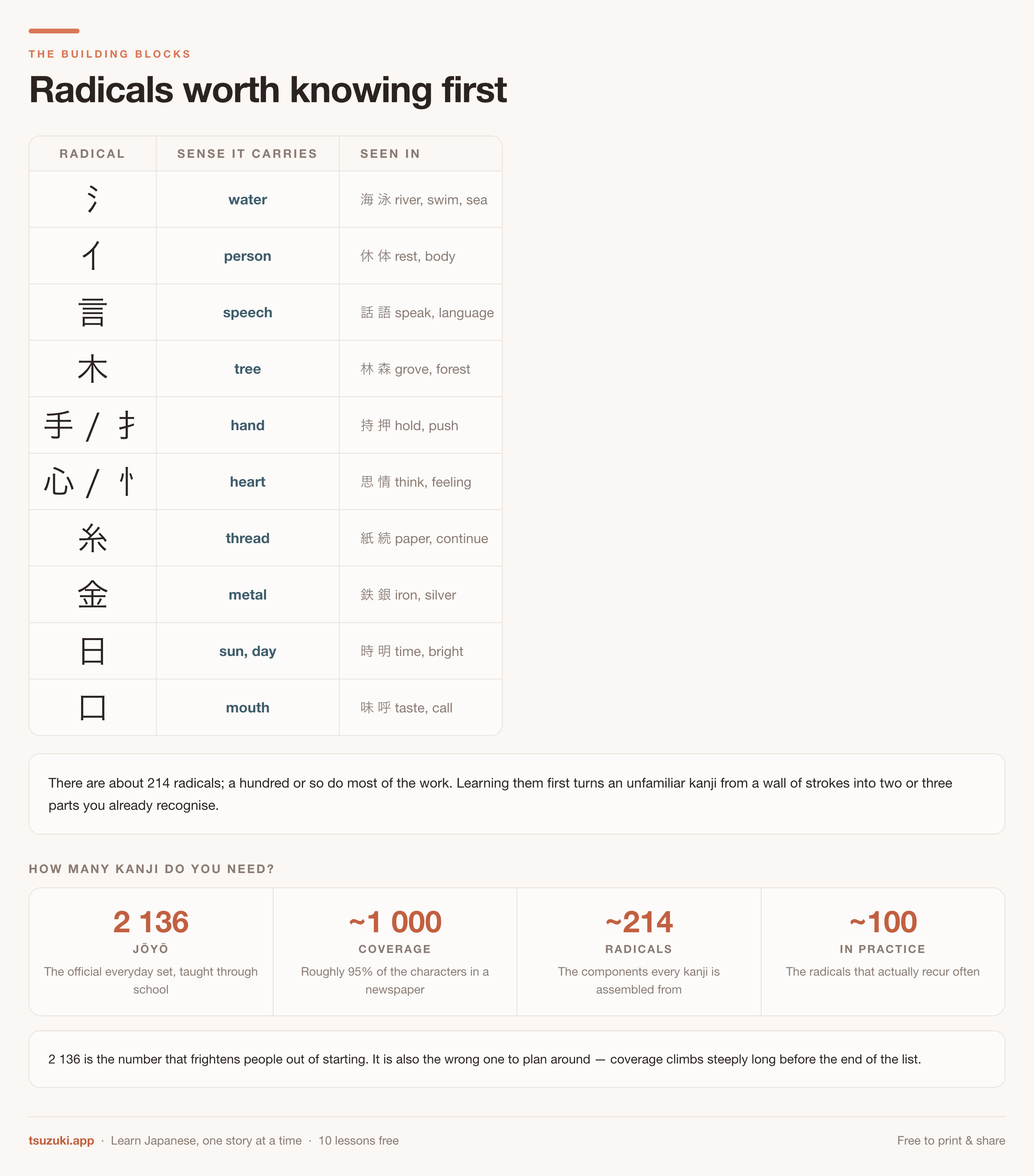
| Radical | Sense it carries | Seen in |
|---|---|---|
| 氵 | water | 海 sea · 泳 swim |
| 亻 | person | 休 rest · 体 body |
| 言 | speech | 話 speak · 語 language |
| 木 | tree | 林 grove · 森 forest |
| 手 / 扌 | hand | 持 hold · 押 push |
| 心 / 忄 | heart | 思 think · 情 feeling |
| 糸 | thread | 紙 paper · 続 continue |
| 金 | metal | 鉄 iron · 銀 silver |
| 日 | sun, day | 時 time · 明 bright |
| 口 | mouth | 味 taste · 呼 call |
Notice 林 (grove) and 森 (forest) — two trees and three trees. Not every kanji is that transparent, but enough are that decomposition pays off immediately.
Learning radicals first is the single highest-leverage move available at this stage. It converts every future kanji from "memorise this shape" into "notice these two parts".
How to actually learn them
The order that works, and it isn't the order a textbook implies:
- Radicals before kanji. Thirty to fifty of the most common ones. A week, and it makes everything after it faster.
- Learn kanji inside words, never alone. A kanji in isolation has several readings and a vague meaning; in a word it has exactly one of each. 水 is ambiguous, 水曜日 is not.
- Use spaced repetition, the same tool that works for kana. Recall, not rereading.
- Notice the phonetic components as you go. You don't need to study them systematically — just register when a component you already know shows up again, and check whether the reading matches.
- Read real text early, with furigana. Slow and painful is correct. This is what converts recognition into reading.
The mistake to avoid: grinding a list of 2,136 in isolation before reading anything. It's the approach that feels most systematic and produces the most dropouts. Kanji learned outside words tend not to stick, because there's nothing to attach them to.
Take the charts with you
The component anatomy, the phonetic series and the radical table, ready to print or keep on your phone: radicals · anatomy · phonetic series. Free, no email required.
Frequently asked questions
How many kanji are there in total? Tens of thousands exist in dictionaries, but the everyday set is 2,136 — the jōyō list. Around 1,000 covers roughly 95% of newspaper text.
What's the difference between kanji, hiragana and katakana? Kanji are logographic — each carries meaning. Hiragana and katakana are phonetic — each is a sound, 46 of each. Kana take about a week; start there.
Why does one kanji have several readings? Japan borrowed the characters from Chinese but already had its own spoken words. Both pronunciations survived: on'yomi (borrowed) and kun'yomi (native). Alone it's usually kun, in a compound usually on.
Are radicals worth learning separately? Yes, and early. They're the components every kanji is built from, so learning a few dozen turns unfamiliar characters into recognisable parts rather than new shapes.
Can I really guess a kanji's reading? Often, yes — for the on reading, when you recognise the phonetic component. 青 signals sei across 晴, 清, 請, 静, 精. It's a strong hint, not a guarantee.
How long does it take to learn kanji? Reading simple real material with a dictionary: a few months. Comfortable newspaper reading: a few years of consistent exposure. The first useful threshold arrives far earlier than the number 2,136 suggests.
Start decomposing, not memorising
The shift that makes kanji manageable is small: stop seeing characters, start seeing components. A radical that tells you the domain, a phonetic piece that tells you the sound, assembled in predictable ways.
2,136 independent drawings is an impossible project. A few hundred parts, recombined, is an ordinary one — and you'll be reading real Japanese long before you reach the end of any list.
Tsuzuki introduces kanji the way you meet them — inside words, inside a continuing story, with a display toggle that lets you read every line as kana, as kanji with furigana, or as raw kanji, so you can lower the support exactly when you're ready. The first 10 lessons are completely free — create an account at tsuzuki.app.
またね! (See you soon.)